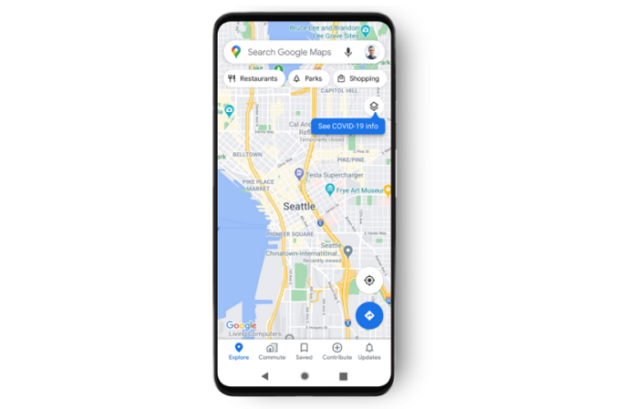

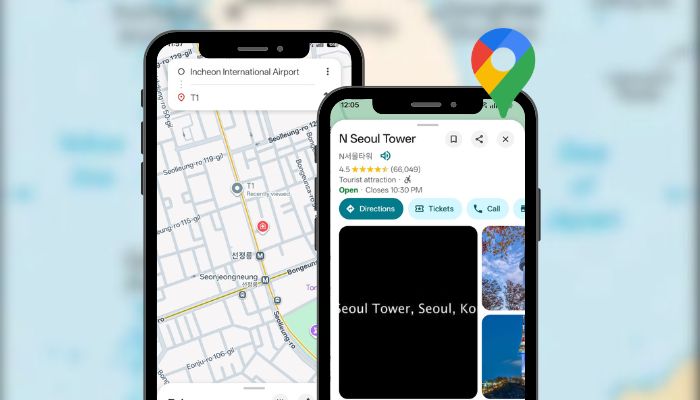
South Korea – Tourists and locals in South Korea may finally get fully functional Google Maps after the government conditionally approved the transfer of high-precision map data abroad. The move comes under strict conditions designed to protect national security.
The Ministry of Land, Infrastructure and Transport, which oversees national mapping policy, made the decision after consulting officials from the foreign, defence and other related ministries, Yonhap News Agency reported.
The approval comes after two previous rejections by Seoul in 2007 and 2016, citing security concerns. The United States had earlier cited restrictions on high-precision map data as a non-tariff trade barrier, according to Yonhap.
Google currently offers South Korean maps using publicly available 1:25,000-scale data, combined with aerial and satellite imagery. The company filed its latest request in February 2025, seeking permission to transfer 1:5,000-scale high-precision map data to its overseas data centres.
This time, Google agreed to comply with South Korea’s security requirements by removing coordinate data for the country and blurring images of sensitive facilities.
“We approved the overseas transfer on condition that Google strictly comply with security guidelines,” the ministry said, as quoted by Yonhap.
The conditions include masking sensitive sites, restricting exposure of precise coordinates, and processing data on local servers before any export.
The ministry further required that Google remove coordinates from South Korean territory and blur satellite and aerial images of military and other sensitive sites in time-series services such as Google Earth and Street View, the Associated Press reported.
Google must also appoint a compliance officer in South Korea to oversee map export issues, and the government may suspend or revoke approval if the company fails to meet these conditions, the ministry said.
In an emailed statement to the Associated Press, Cris Turner, vice president of government affairs and public policy at Google, said the company “welcomes today’s decision and looks forward to ongoing collaboration with local officials to bring fully functioning Google Maps to Korea.”
For years, tourists have expressed frustration over South Korea’s restrictions on Google Maps, making navigation challenging.
Along with China and North Korea, South Korea is one of the few countries where the service is limited or completely restricted. Locals mainly rely on South Korean platforms such as Naver and Kakao for mapping and navigation.