

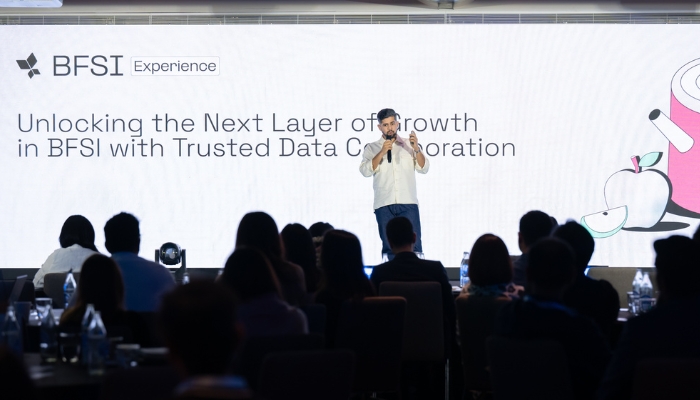
Bangkok, Thailand – When it comes to customer journeys across the BFSI industry in Southeast Asia, the idea of ‘walled gardens’ is now being challenged by fluid ecosystems across wallets, banks, and measurement technology platforms.
Users no longer engage linearly across digital spaces; rather, they journey across omnichannel platforms based on marketing signals that add value to their day-to-day interactions.
The latest State of Finance for Marketers in APAC – 2026 Edition AppsFlyer report, unveiled at the company’s first BFSI Conference in Bangkok, Thailand, held on March 26, highlighted a 193% surge in remarketing investment across Southeast Asia. This signals a stronger shift to retention and engagement for LTV customers, with acquisition costs being five times higher when attempting to onboard new users.
With this in mind, building lifecycle growth-based ecosystems and data collaboration in a privacy-first world is the step for organisations across the BFSI industry.
MARKETECH APAC further explored how this looks across Southeast Asia today, in an interview with Varun Budhiraja, Strategic Sales Executive for Data Collaboration Platform at AppsFlyer, and Juan Carlos Bauza, Vice President for Innovations and Adtech at GCash.

Ecosystem interdependency
Varun highlighted how today’s BFSI industry ushers in an era where privacy is becoming more fundamental for users, who are more aware of the significance of privacy, and for organisations who hold first-party data to remain compliant with regulations.
“This really creates an opportunity for companies that have great first-party data assets to really drive collaboration in the ecosystem,” Varun commented.
“At AppsFlyer for the last decade, our core mission has been to enable advertisers to make better marketing decisions, and our priority remains the same—to bring the larger ecosystem together, be that safe privacy infrastructure that gives confidence to companies to collaborate securely and more privately.”
With AppsFlyer supporting companies to make better and more impactful marketing decisions, GCash has been exploring avenues in the innovation and adtech space for collaboration to deliver marketing signals with real-world outcomes.
“The new technologies we’re trying to build now with AppsFlyer in relation to the data collaboration platform support our goal to unlock how we can improve how advertising is done while bringing the right message at the right time to the right customer,” Juan Carlos shared.
He further explained how GCash’s mission will remain the same in enabling finance for all, especially for the underbanked. To maintain this status quo, the fintech leader has been exploring more business lines for GCash while also helping other non-consumer Filipinos, such as SMEs, large businesses, and advertisers, to leverage GCash data and media to change the way marketing is delivered in the Philippines.
Collaboration is essential for developing lifecycle-growth strategies throughout fluid ecosystems while ensuring data privacy remains at the forefront of the customer journey.

Navigating the privacy utility paradox
As globally privacy standards and regional regulations continue to tighten, organisations in the BFSI industry are now challenged to balance providing ‘insight-driven’ experiences users expect while maintaining compliance with governance standards for financial services and measurement platforms.
“There are technologies such as data clean rooms that allow a secure collaboration through hashed identifiers with the highest level of privacy-enhancing technologies like PII hashing or differential privacy,” Varun explained.
“All of these technologies are built into a structure where it’s never about revealing users’ data but rather gathering insights and making the customer experience better without losing control of the data.”
Varun added how every business today is striving for better customer experience, which is where the entire ecosystem comes into the picture to deliver personalised ads at the right time or complimentary offers that create a meaningful impact in a customer’s life.
For AppsFlyer and their partners, such as GCash, maintaining privacy at the heart of a collaborative ecosystem remains the absolute imperative.
“For us, we’re never going to sacrifice adherence to compliance, regulation, and compliance standards for any sort of money-making or profit endeavour,” Juan Carlos emphasised.
“We will put our customers first. While at the same time, we are at the age of being able to innovate and find technologies that allow us to achieve our mission in a safe way.”
Providing organisations in the BFSI industry with ecosystems and technologies to collaborate with first-party data securely without the risk of compromise is essential for both customers and businesses in an era where privacy is centre stage.

Solving for fragmented customer journeys
Customer experiences are no longer linear across digital spaces in the BFSI industry. User touchpoints are spread across multiple platforms, such as wallets, banks, and technology in Southeast Asia and the APAC markets.
The segmentation between platforms has always been present, as Varun mentioned, “User experience always seems to be broken in some ways, but always striving to become better.”
“Today, there are technologies that exist where you’re able to have a very seamless handoff between one partner to another to really thrive for better user experiences.”
Modern customer journeys are not about having a ‘perfect’ experience across multiple touchpoints— rather, it’s about how the handoff between platforms can be seamlessly executed if the right partners come and use the right neutral technologies without biases or media play, to deliver a smooth transition from one platform to a partner platform.
Juan Carlos highlighted another important point: “Technology is a big part of it, definitely, but at the same time, it’s a willingness for all the ecosystem partners to work together.”
“It will take a lot of evolution in thinking for marketers and advertisers. We still need to work with them, and the brands need to buy into the whole concept, which is where AppsFlyer’s technology can link those partners together.”
The fragmentation of customers’ journeys in BFSI spaces has no one-stop solution. However, providing seamless handoff across the ecosystem can be achieved by partners working together and reducing friction for each user touch point.
Re-evaluating growth: From acquisition to lifecycle value
The recent AppsFlyer report revealed that it is costing organisations in the BFSI industry five times more in marketing costs to acquire new customers compared to reactivating existing users. With this, there is a shift in focus for developing lifecycle-based solutions to focus on customers who have long-term value.
“There’s a great saying somewhere that acquisition is a vanity metric, profitable user is a sanity metric. I think we are really in a place where more companies are rethinking how to keep existing users engaged with their apps,” Varun commented.
“I think marketers with the tools and solutions available are really able to rethink what it takes to keep users engaged and expand lifetime values through data collaboration platforms.”
Meanwhile, Juan Carlos discussed two layers significant for GCash to focus on long-term value for customers.
“There are two layers that you need to think about when it comes to managing user acquisition and retention. One is being able to act on what you know about the customer. The second layer is how you can get more information about the customer you didn’t know with your own data,” he explained.
The focus shifts from monitoring app behaviours to analysing transaction behaviours that tell the story of a specific user, enabling marketers and advertisers to deliver impactful personalised experiences.
“In order to change customer behaviour, you need to get into what will get users to change their behaviour,” Juan Carlos shared.
****
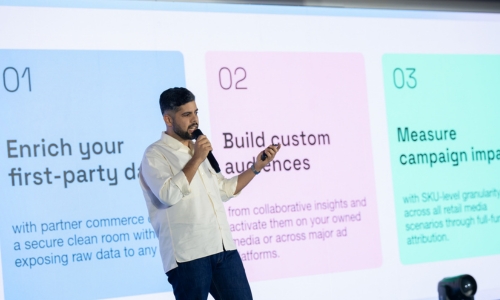
The future of a successful digital infrastructure in the BFSI industry comes down to four areas: data, collaboration, activation, and measurement.
Varun and Juan Carlos both emphasised the importance of a secure data infrastructure to enable collaboration with privacy guardrails through technologies such as data clean rooms, leading to impactful and personalised activation for customers, where marketers and advertisers can analyse measurements through unified platforms.