

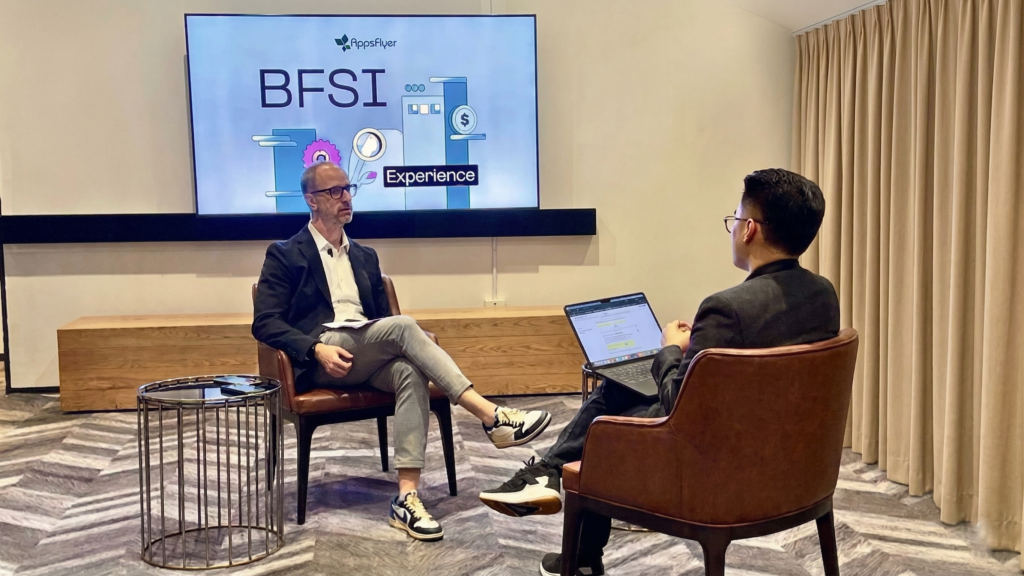
Bangkok, Thailand – Despite initial figures that seem concerning—a 17% decrease in finance app installations and a 27% decline in user acquisition spending across Asia-Pacific—Ronen Mense, President and Managing Director of AppsFlyer APAC, argues that interpreting this situation as a crisis misses the true underlying narrative.
“Growth is actually maturing,” Mense said during an exclusive interview at AppsFlyer’s BFSI Experience 2026 in Bangkok. “Just because you have a drop in the number of installs doesn’t mean things are stalling.”
It was a keynote message that cut through the noise of the data — and one that carries significant implications for every bank, fintech, and financial services brand competing for the APAC consumer.
The era of volume is over: welcome to the lifecycle economy
For years, APAC’s BFSI (Banking, Financial Services, and Insurance) sector rode a wave of aggressive user acquisition. More installs. More spending. More scale. But the latest AppsFlyer State of Finance for Marketers in APAC 2026 report signals that the market has decisively shifted gears.
Mense framed it with a disarming analogy: “Make new friends, but you gotta keep the old.” Acquiring new users — the new friends — still matters, but the strategic weight is now falling on what happens after the install. Onboarding. Retention. Lifecycle value. These are no longer nice-to-haves; they are the new battleground for competition.
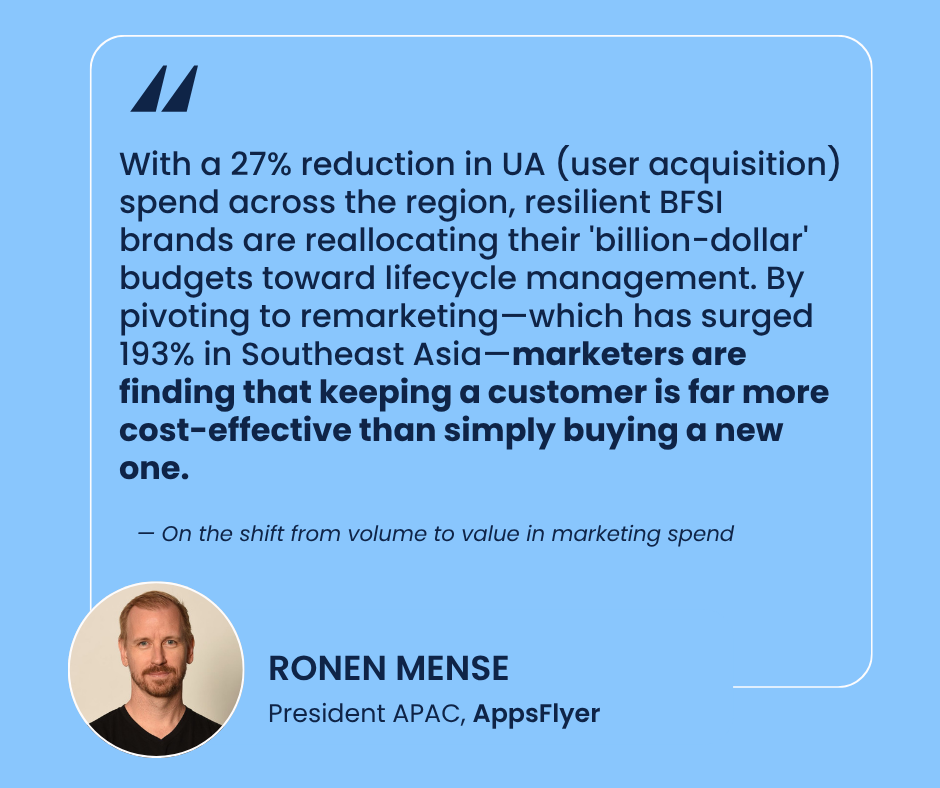
Nowhere is this more evident than in remarketing spend, which surged 193% in Southeast Asia as brands reallocated budgets away from pure acquisition toward re-engagement. Remarketing is less expensive than acquiring a cold user, Mense noted, but critically, it is also proving more effective — particularly when the goal is driving repeat usage and long-term customer value.
“Sometimes you use a product once or twice, and then you fall out,” he said. “Brands want to make sure there is a sustainable purpose why customers are coming back.” Gamification strategies and lifecycle engagement mechanics are increasingly how BFSI players are solving that problem.
The invisible problem: fragmented journeys and data silos
If retention is the new imperative, visibility is the core challenge. The modern financial customer journey in APAC has become deeply non-linear — bouncing across multiple apps, platforms, and partner ecosystems before any conversion occurs. A user might discover a finance product through a social ad, research it on a comparison site, download it via a search result, and complete registration weeks later, after a push notification.
“The customer journey no longer happens in one place,” Mense said. “It bounces everywhere.”
For marketing teams, this fragmentation creates a measurement nightmare. Attribution data sits in silos. Onboarding signals are disconnected from acquisition signals. Remarketing outcomes are tracked separately from lifecycle engagement metrics. The result, as Mense put it, is that “teams struggle to see what’s actually driving engagement and how to extract value across that lifecycle.”
The consequences of this blind spot are not just analytical — they are commercial. Brands that cannot unify their view of the customer journey are making decisions on incomplete data, misallocating budgets, and ultimately losing customers they could have retained.
Better signals, better data, better decisions
So what is the prescription? Mense distilled it into a deceptively simple three-step framework:
- Better Signal
- Better Data
- Better Decisions
The catch is that none of this is achievable without the right foundation. “Data tracking is no longer just a tech job,” he said. “As complexity increases, companies start to lose visibility into what’s really working.”
For BFSI brands — banks, fintechs, insurers, crypto platforms — investing in measurement infrastructure is no longer a back-office IT decision. It is a frontline marketing priority. The ability to measure accurately across any channel, any partner, and any platform is what separates brands that will lead the next chapter of APAC’s digital finance market from those that will be left optimising in the dark.
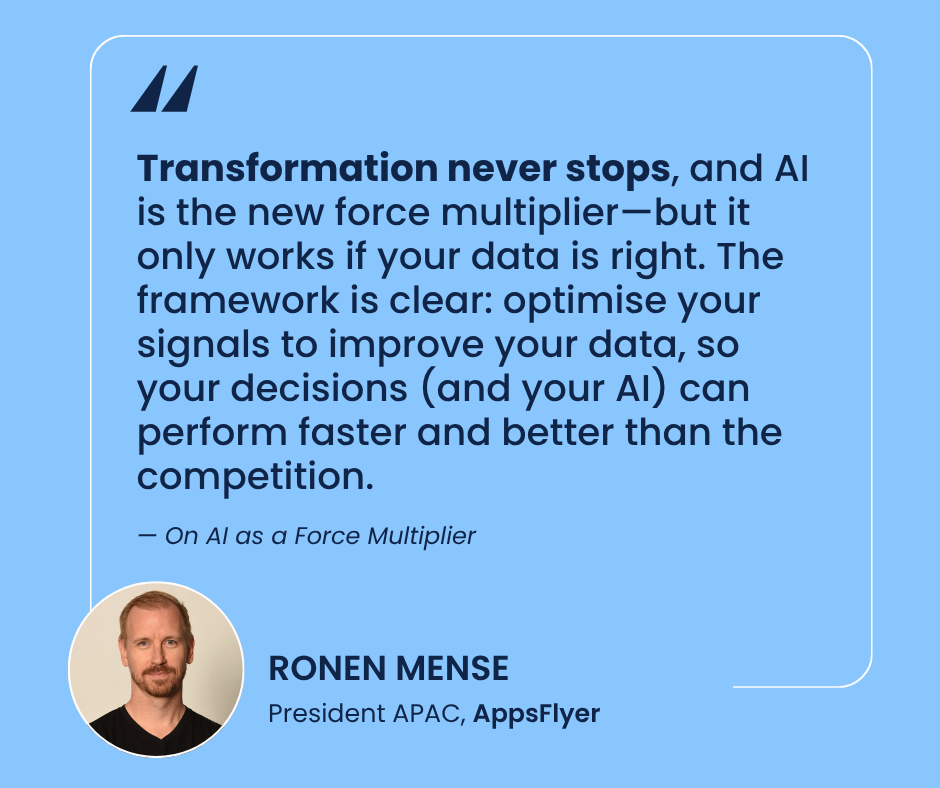
Artificial intelligence is accelerating this urgency. Mense acknowledged that AI is increasingly acting as a “force multiplier” — helping brands move faster and solve more effectively in a retention-first environment. But he was equally clear that AI’s effectiveness depends entirely on the quality of the signals feeding it. Garbage in, garbage out — at AI speed.
The future belongs to those who build now
Looking ahead, the brands that win in APAC’s retention-first economy will be those who invest today in the infrastructure that makes the customer lifecycle visible, measurable, and optimisable. Not just for the markets of 2026 — but for the markets of 2028 and beyond, where the pace of change will only accelerate.
As Mense put it, invoking Peter Drucker: “Invent the future.” Transformation never stops. And for APAC’s BFSI brands, the window to build the right foundation — before competitors do — is open right now, but not indefinitely.
To dive deeper into the data behind these insights, access AppsFlyer’s full report, AppsFlyer State of Finance for Marketers in APAC 2026, here.