

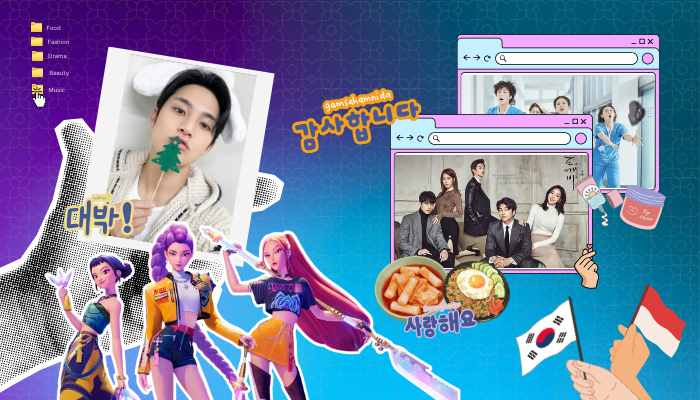
K-Wave has long been a global phenomenon, from chart-topping K-Pop hits to binge-worthy K-Dramas and fashion trends flooding social feeds. But in Indonesia, the influence of Korean culture goes beyond fandom.
For the country’s Gen Z and young Millennials (Gen MZ), K-Wave has been remixed, personalised, and fused with local culture to create what Cheil Indonesia calls “Fusion Culture”—a new cultural operating system that brands can no longer ignore.
In Cheil Indonesia’s latest report, “Beyond K-Wave: The Root of Indonesia’s Fusion Culture”, the agency reveals how K-Wave has evolved from entertainment into everyday lifestyle choices. The findings show that Indonesian Gen MZ aren’t just riding the K-Wave — they’re shaping their own expression.
K-Wave: From trend to daily lifestyle
K-Wave is no longer something Indonesian Gen MZ simply watches on screen — it’s something they live with every day.
The study shows that 90% of Gen MZ express positive interest in K-Culture, while 87% already see it as a long-term lifestyle rather than a passing hype. The journey often starts with K-Pop (79%) or K-Dramas and K-Films (72%), before naturally expanding into K-Food (66%), K-Beauty (44%), and K-Fashion (39%).
Cheil Indonesia emphasises that this adoption is layered and habitual. For many Gen MZ, Korean influence is not just something to watch — it informs daily routines, social expression, and lifestyle choices. K-Wave has moved beyond screens into lifestyle decisions, influencing how they express themselves, what they engage with, and even how they evaluate brands. For many, Korean cultural influence isn’t just something to enjoy; it becomes part of how they live, choose, and connect with the world around them.
Beyond lifestyle, K-Wave serves emotional and social roles: 79% find it inspiring, 51% turn to it as an escape, and 37% see it as a way to project their ideal selves. As one student put it in the survey, “Korean content is more than just fun. It’s my escape. When I’m stressed or tired, it comforts me and helps me forget the pressure, even for a moment.”
In an exclusive interview with MARKETECH APAC, Miranti Sudrajat, head of strategic planning at Cheil Indonesia, said, “While many markets are riding the trend, Indonesia is increasingly building with it—remixing, localising, and making it feel uniquely their own.”
Fusion culture across APAC: Indonesia as a benchmark
Outside Indonesia, other APAC markets are also swept by the K-Wave, which has gradually influenced the culture and lifestyle of Gen MZs. Miranti notes that while K-Wave resonates in countries like Singapore, Thailand, Japan, and Hong Kong, the depth of engagement differs.
These markets are highly receptive, particularly in entertainment-led touchpoints. The signals are clear: frequent K-Pop concerts, active fan gatherings, dance cover communities, and TikTok content that mirrors Korean formats. In many of these markets, K-Wave shows up as pop culture participation — people join what’s trending, share it, and move on to the next wave.
However, Miranti emphasises that Indonesia is different in scale and depth.
“Here, K-Wave has moved beyond fandom into everyday lifestyle fusion. Indonesian MZ don’t only consume K-culture; they actively reinterpret it through a local lens and fold it into daily routines,” she said.
From mixing kimchi with Indonesian noodles to borrowing Korean phrases in casual conversation and adopting K-inspired fashion and grooming in everyday life, Indonesian Gen MZ have made K-Wave unmistakably local. Reflecting this, around 60% of MZ respondents consciously acknowledge K-Wave’s influence on their everyday lifestyle.
This distinction positions Indonesia as a cultural lab for fusion culture, providing lessons for brands across the region on how global trends are absorbed, personalised, and sustained.
Brands and fusion culture: Participation over amplification
Cheil Indonesia’s report also emphasises that brands cannot simply “jump on” K-Wave. While the trend is strong, Gen MZ want brands to blend into how fusion already happens in real life.
In fact, 95% are open to brands that integrate K-Culture meaningfully; however, 98% prefer fusion that starts from local culture rather than imported concepts. For them, Korean elements work best as an ingredient, not the main dish.
Successful engagement requires co-creation and respect for local fusion. Miranti highlights strategies that resonate most:
Effective strategies:
- Co-create, don’t just broadcast: Build opportunities for UGC, customisation, and community-led moments.
- Start local, then fuse: 98% of respondents prefer fusion rooted in Indonesian culture.
- Work with communities, not just celebrities: niche fandoms provide credibility and participation.
Pitfalls to avoid:
- Trend-riding without meaning: K-elements without relevance fail to connect
- Over-Koreanising: Fusion loses authenticity if local identity is ignored.
- One-off hype: Gen MZ values consistent engagement over short-term campaigns
“The most effective approach for brands is to treat Fusion Culture as a collaboration space, giving Gen MZ room to express themselves and take part,” Miranti explained. “This is how brands engage authentically, because Indonesian MZs want to be treated as co-creators, not just audiences. They expect brands to design for participation, not simply borrow the aesthetic.”
The operating system of fusion culture
Cheil Indonesia’s research presents Fusion Culture as a framework—the F.U.S.I.O.N model—which outlines how global culture becomes embedded locally: audiences fuse global influences with local values, use them in daily routines, shape them through personal expression, integrate them into communities, and ultimately own them as part of who they are.
Based on this study, Cheil Indonesia sees fusion not as a creative tactic but as a broader strategic role brands can play in culture. This reframes how brands show up — moving beyond trend amplification toward cultural participation.
To stay relevant, the report urges brands to build platforms that invite remixing, create ideas designed to live beyond launch moments, and anchor global inspirations in local truths.
Implications for APAC marketers
Looking ahead, Miranti notes that APAC marketers should focus on participation by design, creating flexible ideas that audiences can remix, adopt, and embed in their communities and daily lives.
“From our report, Indonesian MZs are moving from passive consumption to active cultural participation. They don’t only watch; they comment, remix, share, and turn trends into social conversation. That means brands should design for participation by default: flexible ideas that the audiences can adapt into their own identity, community rituals, and everyday life,” she explains.
In terms of platforms and behaviours to watch, TikTok remains the key discovery engine — a “melting pot” where trends travel fast across backgrounds and countries.
Miranti said, “We also see the influence moving both ways; it’s not only Indonesians picking up Korean formats, but Koreans are also catching Indonesian trends, often surfaced through TikTok. For marketers, this signals that the next wave of fusion culture will be shaped by cross-market feedback loops: what starts local can scale global when it’s culturally resonant and easy to participate in.”
The report concludes with a clear message for brands:
“K-Wave isn’t a shortcut, and Gen MZ can tell. To stand out, brands need to move past trend-chasing and start building culture, not just borrowing it.”
*******
As global culture continues to move at speed across borders, Indonesia’s Gen MZ offers a clear signal for regional marketers: influence no longer flows in one direction. In the era of fusion culture, relevance is earned not by amplifying what’s trending, but by enabling audiences to reinterpret and make it their own.
For APAC brands navigating global-to-local tensions, the opportunity lies in shifting from visibility to participation — and in designing ideas that live, evolve, and scale with the communities that shape them.










![[Partnership] Sanrio IP](https://marketech-apac.com/wp-content/uploads/2026/07/Partnership-Sanrio-IP.webp)