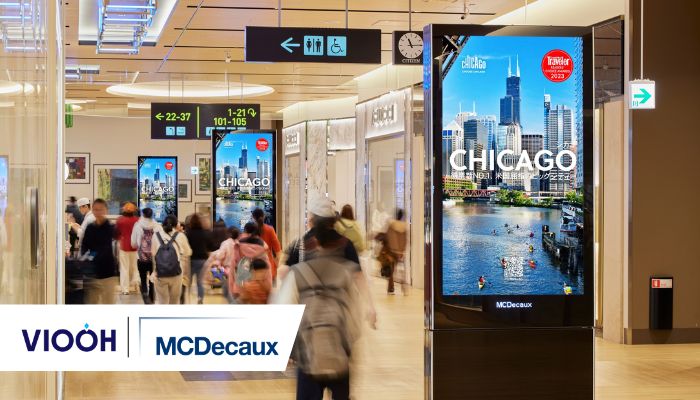

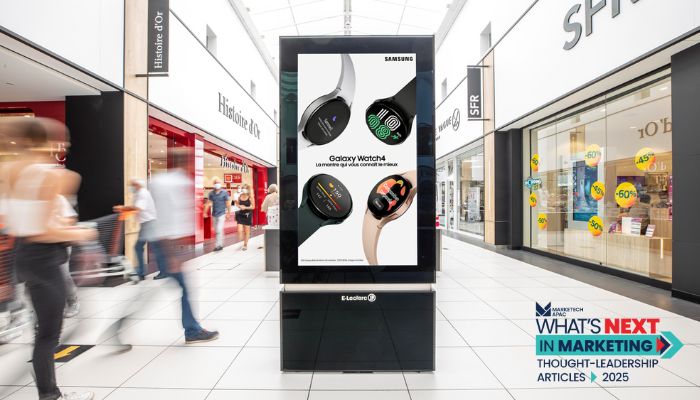
Forget everything you know about billboards. The out of home (OOH) advertising industry is witnessing two parallel changes: key global trends are reshaping the programmatic landscape, and AI is fundamentally reimagining what’s possible. Together, they’re reshaping how we plan, execute and measure campaigns in the physical world, turning OOH from a supporting player into a hero media channel.
Global trend #1: Programmatic adoption and multi-channel integration
The shift to programmatic means digital out of home (DOOH) is joining the omnichannel party. Agencies can now leverage their data from other channels, buying audience segments across multiple DOOH media owners just as they would across any digital channel.
For example, Dell’s recent multi-channel campaign incorporated programmatic digital out of home (DOOH) alongside mobile and desktop. It achieved a six-point uplift in purchase intent and doubled click-through rates compared to campaigns without pDOOH. This isn’t just channel addition, it’s channel multiplication.
The challenge to date has been operational complexity. Media agencies need simple solutions, not separate multiple private marketplace (PMP) deals per media owner. Supply-side platforms (SSPs) that can curate inventory across several operators in different markets will ultimately become the platforms of choice. This will encourage new investment, which complement classic PMP purchases, rather than redistribute existing budgets.
Global trend #2: More buyers for pDOOH, spending more money
The numbers tell a compelling story. According to VIOOH’s State of the Nation research, media professionals globally anticipate an average increase in pDOOH investment of 28% over the next 18 months.
So, what’s driving this? Speed, accessibility and effectiveness. Programmatic DOOH delivers all three – and consistently delivers measurable lift across the purchase funnel. Campaigns that once took weeks to plan and execute can now launch in hours. Inventory that was previously inaccessible to smaller advertisers is now available programmatically, with significantly lower barriers to entry in terms of advance booking, minimum budgets, and relevance.
Global trend #3: Cross-border bookings & regional growth
Global advertiser bookings are also increasing YOY. In the 2024 State of the Nation report, 17% of respondents had booked global campaigns compared with 10% in 2023, with regional campaigns (e.g. within Europe or North America) holding steady at 25%. At VIOOH, we are continuing to see growth in multi-market campaigns, which accounted for 37% of our H1 2025 revenue. This demonstrates that programmatic isn’t just about enabling scale in DOOH, it’s also about sophisticated cross-border targeting.
For example, ByteSIM’s campaign to build brand presence and capture attention amongst consumers travelling from Singapore’s Changi Airport to Japan and South Korea achieved 310,000 impressions and a scan-through rate five times higher than baseline. In another campaign, Dreame, entering the US market from China, targeted CES attendees at LAX and saw an 18% shift in purchase intent, overtaking two competitors in its category. These examples demonstrate repeatable, easy-to-scale strategies for brands advertising outside of their home markets.
Global trend #4: Data & dynamic creative
Dynamic Creative Optimisation (DCO) has evolved from a novelty to a necessity. Campaigns can now respond to multiple data inputs simultaneously including weather, pollen counts, sports scores, location data, sales figures and behavioural patterns.
Cadbury’s Creme Egg ‘Hunt the Winning Eggs’ UK campaign exemplifies this evolution. It used real-time data to update messaging about the number of chocolate eggs found and remaining, while adjusting the creative based on environmental factors, such as the nearest location to the screen of recently found eggs. This enables living campaigns operating in real-time that feel immediate and relevant, dramatically increasing engagement and recall.
The AI effect in DOOH: From enhancement to transformation
AI is the industry’s favourite buzzword at present, and isn’t only optimising what we already do, but enabling entirely new capabilities.
Consider campaign planning. When someone says, “I want to target coffee lovers in Soho,” AI can identify all relevant points of interest including cafes, bakeries, coffee shops, tea rooms, patisseries, and food courts, and then map available inventory. It can generate proposals and deals while maximising the reach and likelihood to meet budget requirements and desired impact. This isn’t just faster; it’s more comprehensive, catching semantic connections that humans miss.
AI also impacts creative production and increases creative variations while handling approval workflows and automatic resizing across formats. AI-powered visual moderation can ensure brand safety and compliance, while predicting audience attention patterns, capabilities that didn’t exist until recently.
But the real game-changer is attribution and optimisation. Machine learning now provides demand forecasting at scale, offering predictability for media owners while optimising yield. AI doesn’t just help find inventory, it optimises the entire bid stream, scaling campaigns while reducing costs. Post-campaign, these systems automatically reallocate budgets based on real-time performance.
We’re already seeing AI handle inventory forecasting, dynamic pricing, traffic shaping, fraud detection and prevention, outcome prediction and bid scoring, transforming every aspect of the DOOH ecosystem.
The convergence creates the future
What makes this moment extraordinary isn’t just AI or programmatic, it’s their convergence. Programmatic provides the infrastructure for omnichannel campaigns. Dynamic creative makes them relevant. Cross-border capabilities provide scale. And AI makes it all accessible, efficient and measurably effective.
For those of us who remember manual booking processes and static billboards, this transformation is breathtaking. We’re not just digitising outdoor advertising, we’re reinventing it as a data-driven, AI-powered channel. One that can stand shoulder-to-shoulder with any digital medium, while maintaining the unique impact only physical world advertising can deliver.

This thought leadership piece is written by Jean-Christophe Conti, Chief Executive Officer at VIOOH.
The insight is published as part of MARKETECH APAC’s thought leadership series under What’s NEXT in Marketing 2025, a multi-platform industry initiative which features marketing and industry leaders in APAC sharing their marketing insights and predictions for 2025 and beyond.