
Bangkok, Thailand – In Bangkok’s increasingly crowded battle for tourist wallets and consumer attention, Siam Piwat Group is making a larger wager: that the future of retail will depend as much on climate credentials as luxury brands and foot traffic.
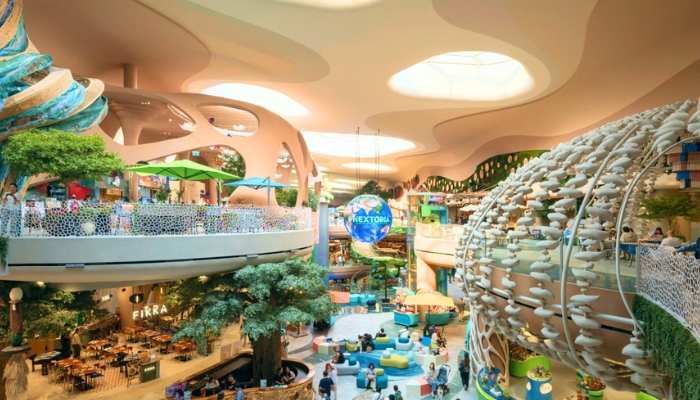
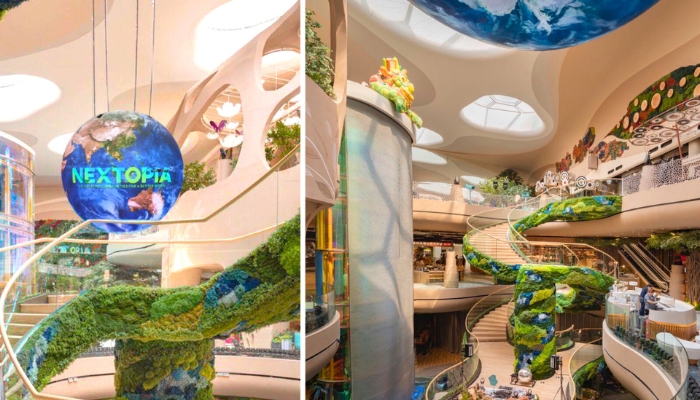
The Thai retail giant has unveiled NEXTOPIA at Siam Paragon, positioning the 15,000-square-metre project as the world’s first prototype for a global sustainability platform embedded within a retail environment.
The launch comes as shopping mall operators across Asia-Pacific face mounting pressure to reinvent physical retail beyond consumption alone.
NEXTOPIA was formally introduced during The Economist Sustainability Week Asia, where Siam Piwat Chief Executive Officer Chadatip Chutrakul framed the initiative as a long-term business transformation rather than a corporate social responsibility exercise.
“Sustainability is no longer optional,” Chutrakul said. “We must accelerate and make a bold move. Real, lasting impact is never created alone. It requires co-creation across industries, united by purpose, in a place that captures the world’s attention and inspires change for the greater good.”
Opened in November 2025, NEXTOPIA sits inside Siam Paragon, one of Thailand’s highest-traffic retail destinations, which attracts more than 200,000 visitors daily, including large volumes of international tourists and regional luxury shoppers.
Rather than functioning as a standalone green showcase, the project attempts to integrate sustainability directly into the retail journey itself.
Interactive installations allow visitors to generate electricity through kinetic flooring and bicycles, while recycled art exhibitions and environmentally-focused retail concepts are positioned alongside conventional shopping experiences.
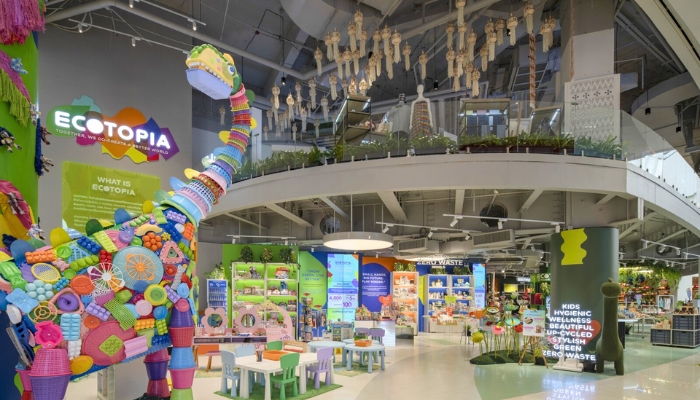
At the centre of the development is ECOTOPIA, described by the company as Thailand’s largest eco-focused retail store, carrying more than 110,000 sustainable products sourced from roughly 300 Thai communities and small businesses.
The project was developed alongside more than 50 corporate and institutional partners, including B.Grimm, SCG, Indorama Ventures, and Kasikornbank.
Global organisations including the World Wide Fund for Nature, World Food Programme, and United Nations Development Programme also participated in collaborative programming.
Siam Piwat said the site has already achieved zero waste to landfill while cutting energy consumption by 47%, reducing water usage by 34%, and lowering carbon emissions from construction materials by 59%.
The building has received EDGE Advanced certification and a two-star Fitwel rating, alongside the Best in Building Health Award 2026 from Fitwel.
Importantly, the sustainability framework extends to tenants themselves. Businesses operating within NEXTOPIA are required to comply with roughly 50 sustainability standards covering waste management, sourcing, and operational practices—a sign of how landlords across the region are beginning to push environmental requirements deeper into commercial ecosystems.
For Siam Piwat, NEXTOPIA is intended as both a showcase and exportable model.
The company said the platform is designed to function as a “living laboratory” that other retail and real estate operators globally could adapt as pressure intensifies on brands and property groups to demonstrate measurable sustainability action under evolving climate commitments.

![[Campaign] AIA Earth Day](https://marketech-apac.com/wp-content/uploads/2026/04/Campaign-AIA-Earth-Day.jpg)