
As one of the most digitally dynamic and demographically diverse regions in the world, Asia-Pacific continues to redefine what’s possible in modern advertising. For brand marketers and advertising vendors alike, the region presents both vast opportunity and increasing complexity.
Shifts in media consumption, platform fragmentation, privacy regulations, and heightened demand for personalisation are reshaping how campaigns are planned, executed, and measured.
With emerging markets leapfrogging into mobile-first behaviours and mature economies pushing the boundaries of programmatic and data-led marketing, staying competitive requires more than regional presence — it demands deep market insight and agile execution.
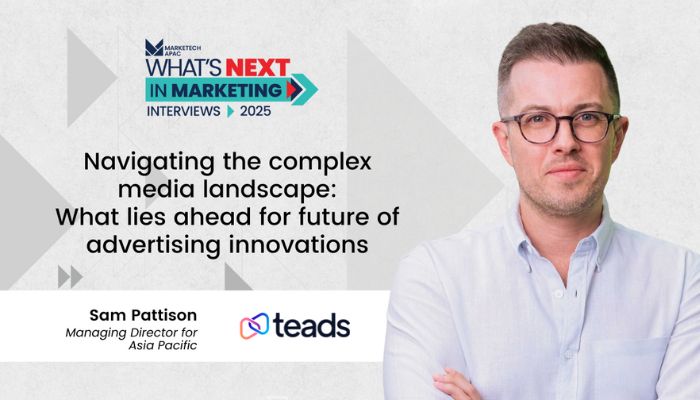
For our latest What’s NEXT in Marketing 2025 interview, we recently spoke with Sam Pattison, managing director for Asia-Pacific at Teads to discuss how the recent Teads-Outbrain merger is a “game changer” for the advertising industry, the truth on a “cookieless” future for the industry, and what lies ahead for advertising in APAC this 2025 and beyond.
Barely scratching the surface of advertising innovations
For Sam, the term “barely scratching the surface” is still relevant for the advertising industry, especially for them at Teads. He even quipped that it is like “the catchphrase that keeps on giving,” because innovation in advertising never really stops.
For him, “scratching the surface” isn’t just a slogan—it’s a guiding philosophy that encourages the company to always push further.
“Even when we think we’ve kind of solved for something or we’ve got like very good, all of a sudden there’s a significant shift in the way the industry is or the businesses. And no matter how fast we move, how quickly we grow, there’s always more that we could be doing from an innovation standpoint,” he explains.
Given that the changes in the advertising industry revolve from new technologies, new regulations, as well as changing consumer behaviours–having a forward-thinking approach in the industry is important, as it acknowledges the fluidity of the current landscape, resulting in actively embracing a culture of “continuous reinvention” to stay ahead.
Teads-Outbrain merger: bringing together “best of capabilities”
Earlier this year, the merger between Teads and Outbrain was completed–worth $900m–creating more unified branding and performance solutions to form an omnichannel outcomes platform for the open internet.
For Sam, the merger enables the combined company to deliver seamless, cookie-less, full-funnel advertising solutions. Moreover, with a focus on performance, brand building, and the premium open web, he also states that the merger positions Teads as a clear alternative to social media and walled gardens.
“What we’ve really done is to bring together sort of the Teads that I’ve been a part of for a long time, which kind of offers the best like full funnel media, more in the kind of upper middle funnel, and then Outbrain who’ve really been specialists in performance-driven outcomes for a long time as well — under one kind of unified platform built for the open web and beyond that now,” he explained.
Sam also emphasises that the merger enables Teads to pivot even more confidently to cookie-less advertising models, more specifically using real-time contextual and attention signals, as well as moving away from third-party data dependency.
For him, Teads aims to offer transparency, brand safety, and accountability, especially in trusted editorial environments.
“Moving into 2025 and beyond…there are a few things that I think are going to be extremely crucial and are solved — or we will try to solve — as part of the merger, which is that move from third-party data to things like real-time contextual and attention-driven signals, trying to give alternatives to walled gardens,” he said.
Same added, “This is something that clients continuously come to us and ask about: reaching high-quality audiences in more trusted environments, editorial environments, with more transparency.”
On a “cookieless” future for advertising
The shift to “cookieless” solutions was something that Teads already had considered years ago, Sam stated, noting that they had been actively running cookieless campaigns since 2018.
He also mentioned that they have conducted over 2,000 head-to-head tests comparing cookie-based versus cookieless campaigns, stating, “Whether it’s upper funnel branding metrics or more hardcore media metrics, the performance holds. In fact, in some cases there’s a slight increase in cookieless outcomes, but it’s negligible. And I guess that’s the point: clients want to know that removing cookies doesn’t remove performance, and we’ve shown that it doesn’t.”
Whether the cookies are going away or not, Sam states that brands should still future-proof their advertising solutions, adding, “The ecosystem is changing—with privacy, with regulations, with the growth of iOS and Firefox—and advertisers are already losing half their audience by relying on cookies anyway.”
In terms of sustainability in the industry, Sam states that it isn’t all about carbon measurement but also sustainable KPIs, sustainable ecosystems, attention, and context.
“Whether it’s performance marketing or full-funnel, it shouldn’t really matter. We have scalable options, and you don’t need cookies to deliver anymore,” he added.
Trends shaping APAC’s advertising scene.
Sam highlighted how dynamic and diverse the APAC advertising landscape truly is. While AI and digital transformation continue to grab headlines, Sam says the most dominant concern among marketers in the region is something deceptively simple: ROI.
“Whether it’s a full-funnel brand campaign or a lower-funnel performance push, advertisers across APAC are increasingly demanding concrete results,” he says.
Another major shift is the surge of connected TV (CTV) adoption in countries like Australia, India, and South Korea. In response to this, Teads is capitalising on this trend not just through traditional OTT, but by integrating directly with smart TV home screens via partnerships with LG, Samsung, and Vida.
For them, this allows advertisers to reach audiences in previously inaccessible, premium digital spaces—especially those who have moved away from linear television entirely.
Looking ahead, Sam paints a clear and compelling vision of where Teads is going: they aim to be the go-to platform for the premium open internet. But as he points out, the definition of “open internet” has changed. It’s no longer just websites and mobile apps — it now includes CTV, mobile native, display, interactive environments, and even emerging touchpoints like electric vehicle screens.
Moreover, Teads’ long-term strategy is rooted in unifying these channels under one flexible platform, allowing marketers to run contextually relevant, attention-based campaigns that reach users across devices, formats, and moments.
“Advertisers have been stuck choosing between high performance and high transparency. What we’re building at Teads is a platform where you don’t have to make that trade-off. The open internet is no longer just a backup plan to social — it’s the main stage for storytelling, performance, and accountability,” he concluded.
Check out the highlights of the interview in our YouTube video below. For the full version of this topic, head over to our official Spotify and check out the full conversation.