
Sydney, Australia – TBWA\Eleven Australia and mycar Tyre & Auto have launched The Sunburnt Car, a campaign designed to highlight the often-overlooked risk of ultraviolet (UV) exposure while driving.
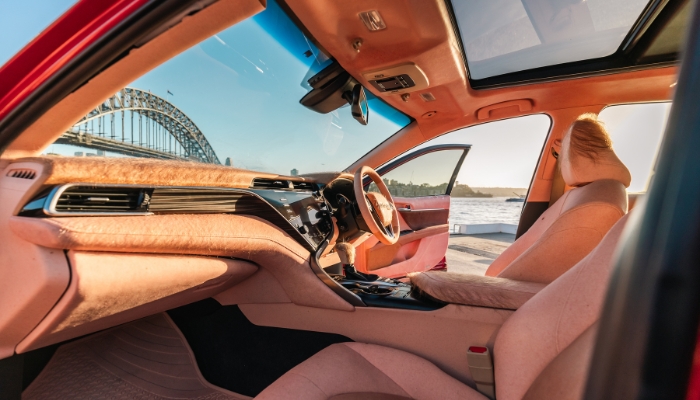
The initiative features a vehicle reupholstered with UV-reactive synthetic “human-like skin,” created to visibly demonstrate the effects of prolonged sun exposure inside a car. The installation debuted at Circular Quay.
The campaign follows new national research commissioned by mycar Tyre & Auto that suggests a gap between Australians’ perception of sun safety and actual behaviour. While 92% of respondents said they consider themselves sun safe, 72% reported overlooking sun protection while driving or riding in a vehicle.
The study also found that 70% believe they are protected from the sun while in the car, despite standard car windows not fully blocking harmful UV rays, and 39% incorrectly believe car windows block those rays altogether. In addition, 65% said they do not apply sunscreen before driving.
According to the findings, sun protection is commonly practiced in outdoor settings such as beaches and parks, but is often neglected during routine activities such as commuting.
To draw attention to the issue, the campaign’s central installation features a car interior designed to mimic human skin that reacts to UV exposure. As the interior is exposed to sunlight, the material visibly “burns,” illustrating how damage can accumulate over time.
Simon Hayes, creative director at TBWA said: “The idea was to make the invisible UV risk we take every day visible in an unignorable — and frankly, unhinged — way.”
The work was developed with Odd Studio, a Marrickville-based prosthetic and creature effects studio, and informed by medical input from Joanneke Maitz.
Meanwhile, Archana Murugaser, creative director at TBWA said: “Our incredible partners took the craft to the next level, ensuring every part of the synthetic skin reflected exactly what happens to human skin when exposed to UV.”
Odd Studio used the Fitzpatrick Scale to represent different Australian skin tones in the design of the installation. Individual details such as freckles, moles and hairs were applied to the material to create a realistic interior appearance. Some moles were designed to resemble potentially cancerous ones to reinforce the campaign’s health message.
Dr Maitz said: “Many Australians do not realise that UV exposure in the car creates damage over time, and it can be just as harmful as time spent outdoors if UV levels are high. Damage to your skin can happen without the visible effects of burning.
“Although UVB, the main cause of visible sunburn, does not typically penetrate glass, UVA does, reaching deeper layers of the skin where it contributes to long-term DNA damage and ageing. Window tinting and treatments can reduce this exposure, but driving with windows or the roof open allows the full UV spectrum through.”
Adele Coswello, chief customer officer at mycar Tyre & Auto said: “At mycar, our commitment extends beyond tyres and vehicle servicing — we genuinely care about our customers. Our research showed in-car sun exposure is an area where more awareness is needed.
“Australians spend significant time behind the wheel driving on average 12,000kms a year, behind only the US and Canada, and our research showed this is an area where more awareness is needed. Sunburnt Car was created to bring that message to life in a way that could prompt action.”
The campaign also features Anne Gately as an ambassador.
Gately said: “As someone who survived stage IV melanoma, I know firsthand how easy it is to underestimate the sun and what it takes to truly protect yourself. The Sunburnt Car makes this danger visible and tangible, and I stand behind a project that could genuinely save lives by reminding Australians that sun safety is not optional.”
In addition to the installation, mycar Tyre & Auto is distributing 55,000 free Sun Spot UV stickers through its network of more than 275 locations nationwide and online. The stickers change colour when UV is detected, providing drivers and passengers with a visual reminder to apply sun protection.
The campaign combines behavioural research, practical tools and a visual demonstration to address what organisers describe as a common blind spot in everyday sun safety.