
Singapore – The number of active users of Google’s Gemini app in Southeast Asia has more than doubled over the past year, underscoring the region’s growing appetite for artificial intelligence tools and positioning it as one of the fastest adopters of Google’s AI offerings globally.
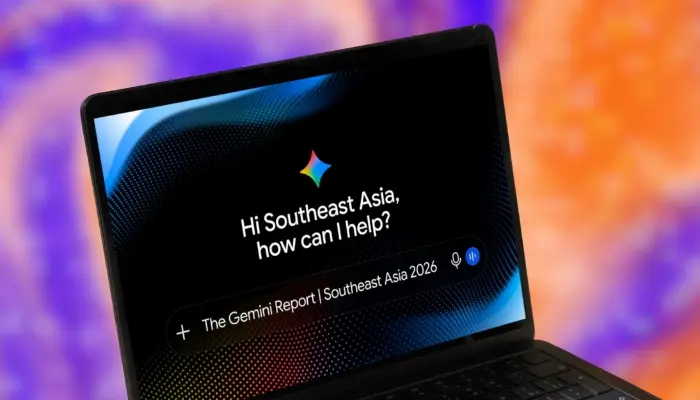
The findings come from Google’s inaugural Gemini Report: Southeast Asia 2026, which examines usage trends across Indonesia, Malaysia, the Philippines, Singapore, Thailand, and Vietnam.
According to the report, Gemini has also become the fastest-adopted Google application in the region and is the most searched-for AI assistant in markets including Indonesia, Thailand, and Vietnam.
The growth is being fuelled by Southeast Asia’s young and digitally connected population, with nearly 40% of residents under the age of 25.
Google found that younger users are emerging as the platform’s most active audience, generating more requests, engaging in longer conversations, and crafting more detailed prompts than older age groups.
Language accessibility has also played a key role in adoption.
Nearly 70% of prompts submitted through Gemini in Southeast Asia are written in local languages, with usage particularly high in Vietnam (89%), Thailand (87%), and Indonesia (84%).
Google noted that Gemini was ranked the top-performing large language model for Southeast Asian languages in AI Singapore’s SEA-HELM evaluation benchmark.
The report also highlighted how users are increasingly moving beyond text-based interactions.
Almost three-quarters of Gemini requests in the region now originate from mobile devices, while more than 40% of prompts involve multimodal inputs such as voice, images, or video.
Voice-only interactions account for more than 10% of total prompts.
Creative applications are likewise gaining momentum. Around 40% of queries involve generating new content, including images, music, videos, and written material.
Google said users across Southeast Asia created more than five billion images using its Nano Banana image-generation model over the past year, alongside nearly one million songs generated through its Lyria 3 music model.
Beyond content creation, users are increasingly relying on Gemini for research, information synthesis, and decision-making.
Common use cases include summarising documents, analysing data, generating recommendations, and troubleshooting everyday problems.
Among Southeast Asian markets, Singapore recorded the highest per-capita Gemini adoption globally and emerged as the region’s fastest-growing market. Active users in the city-state more than doubled during the final months of 2025, driven largely by young professionals aged 25 to 34, who account for around 40% of daily users.
Google said productivity remains the dominant use case in Singapore, with nearly four in ten user journeys focused on work-related tasks such as coding assistance and technical problem-solving.
However, lifestyle-related queries, including travel planning and personal finance, become significantly more prominent during weekends.
Looking ahead, Google is expanding its AI agent capabilities through Gemini Spark, a new feature designed to proactively complete tasks on behalf of users.
Initially available in English for Google AI Ultra subscribers, the feature is beginning to roll out in Southeast Asian languages this week.
Sapna Chadha, Vice President for Southeast Asia and South Asia Frontier at Google, said the findings show AI has moved beyond experimentation in the region and is increasingly becoming part of everyday life.
“People aren’t just adapting to Gemini, they are using it in their own ways — in modalities they prefer, in languages they speak, and in contexts unique to their lives,” she said. “Gemini is no longer a tool for tomorrow, but an indispensable companion that is already shaping how we work, study, and live today.”

![[Tech] Globe Business x Gemini](https://marketech-apac.com/wp-content/uploads/2026/06/Tech-Globe-Business-x-Gemini.jpg)
![[Launch] Grayling GEO Radar](https://marketech-apac.com/wp-content/uploads/2026/05/Launch-Grayling-GEO-Radar.jpg)