
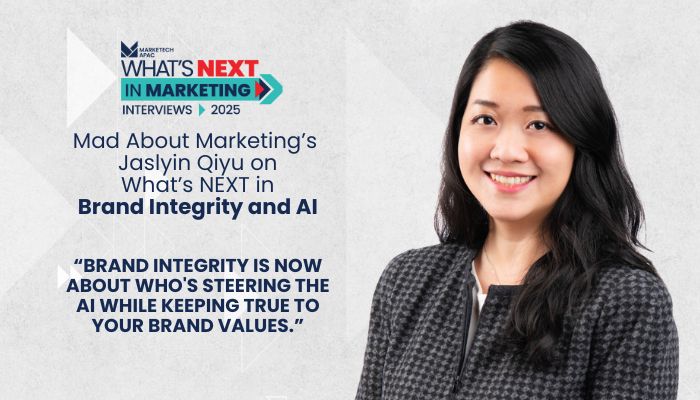
In an era where algorithms can generate stories, visuals, and even emotions—brand integrity has become both the challenge and the compass for modern marketers.
For Jaslyin Qiyu, former managing director of Mad About Marketing, this integrity is not about perfection—it is about authenticity, accountability, and the human judgment that no machine can replicate.
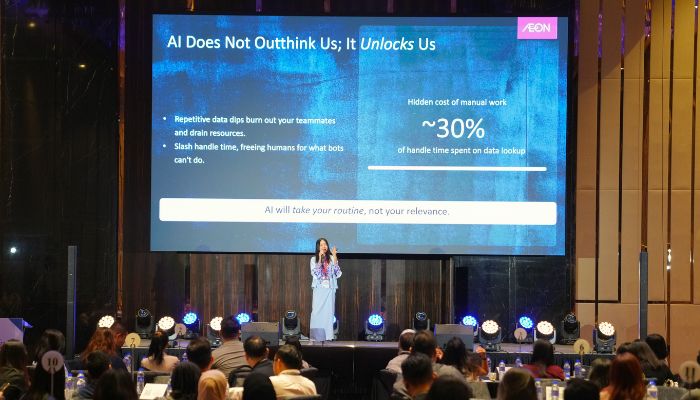
In MARKETECH APAC’s What’s NEXT in Marketing series, Qiyu explores how brands can protect authenticity while embracing the speed and precision of artificial intelligence—proving that integrity, not imitation, is the true currency of modern marketing.
AI, authenticity, and accountability
Qiyu described ‘brand integrity’ as the consistency between what brands say they are and what they deliver.
As artificial intelligence shapes how brands market themselves, Qiyu explained that ‘brand integrity is now a distinguishing factor in knowing if brands understand authenticity while utilising AI.
“It’s not about whether you use AI; it’s about whether AI serves your actual values or just mimics the aesthetic of those values,” she elaborated.
That distinction, she added, has become crucial in an age where “audiences can spot synthetic authenticity instantly.”
When every brand can produce polished output, she explained, the differentiator is the human vision steering the tools, “Brand integrity is now about who’s steering the AI while keeping true to your brand values, not just what the AI produces.”
The human edge in a machine-driven world
For Qiyu, AI and emotion are not opposites—they are counterparts.
“The balance isn’t about choosing between AI and human emotion—it’s about using AI to create more space for human judgment and authentic human emotions, not less,” she said.
She noted that AI should handle precision work—data analysis, pattern recognition, and A/B testing—so marketers can focus on “understanding cultural nuances, making values-based decisions, and creating moments that resonate because they are rooted in genuine human insight.”
Transparency, she believes, is key to sustaining trust.
“Trust isn’t built by avoiding AI. It’s built by being transparent about where you use it, how you use it, and demonstrating that human expertise and empathy still drive your strategic decisions. Use AI to amplify your best people, not replace them,” she asserted.
Ethics, empathy, and the new creative guardrails
Qiyu believes the future of ethical marketing begins by defining limits before possibilities.
“Start by defining what AI shouldn’t do, not just what it can,” she said. “Establish clear domains and guardrails where human judgment is non-negotiable—crisis response, values-driven messaging, community relationships, and creative risk-taking.”
Her framework includes transparency protocols, diverse human oversight, and regular brand audits to ensure that AI outputs align with—not merely imitate—a brand’s voice.
“Your brand voice isn’t just linguistic patterns AI can learn—it’s the accumulated judgment, cultural awareness, and values of your brand,” she reminded.
Future-proofing brand storytelling
As technology evolves, Qiyu said the most enduring assets will remain deeply human.
“Invest in what AI can’t replicate: deep category expertise, cultural fluency, strategic yet empathetic judgment, and the ability to take informed creative risks,” she advised.
Agility, she believes, “comes from having strong enough foundations—in values, expertise, and relationships—that you can experiment confidently. AI should accelerate your learning loops, not replace your learning and critical thinking capability.”
In the age of algorithmic targeting, Qiyu warned against what she calls “creepy precision.”
“Algorithmic personalisation optimises for patterns, not people,” she said. “Just because you can demonstrate you know something about someone doesn’t mean you should. It’s a fine line between hyper-personalisation and right of choice.”
Her advice is to let customers control their data, use AI to identify where brands can genuinely help, and always ‘test for creepiness, not just conversion.’
Leadership that outthinks the algorithm
Looking ahead, Qiyu believes the most powerful leaders will be those who pair discernment with empathy.
“The critical skill isn’t learning to use AI—it’s knowing when not to,” she said.
She calls it a ‘stewardship mindset’—protecting what makes a brand worth engaging with, “Sometimes the AI version is good enough technically but wrong strategically.”
Ultimately, Qiyu believes the brands that win “won’t be the fastest AI adopters—they’ll be the ones who use AI to enable their best human judgment to operate at scale.”
For Qiyu, the rise of AI is not the curtain call for human creativity—it is its evolution. In marketing, she sees it as an invitation to deepen rather than dilute authenticity, giving brands new ways to express intent and emotion with precision.
When guided by human judgment, AI becomes less about automation and more about amplification—of purpose, empathy, and imagination.
And while AI may power the engines behind modern campaigns, it is still human creativity that gives them soul. Algorithms can optimise reach, but only people can inspire resonance.
In the end, it is human ideas—anchored in integrity and designed with intent—that build the lasting connections between brands and the audiences they hope to move.
Jaslyin Qiyu was also recently appointed as the chief marketing officer and head of customer experience, Singapore and Australia of Cigna Healthcare.