

There isn’t a fixed number of communication styles and theories in existence, but a common premise is that it starts with either the purpose or the sender, depending on which lecture one attended.
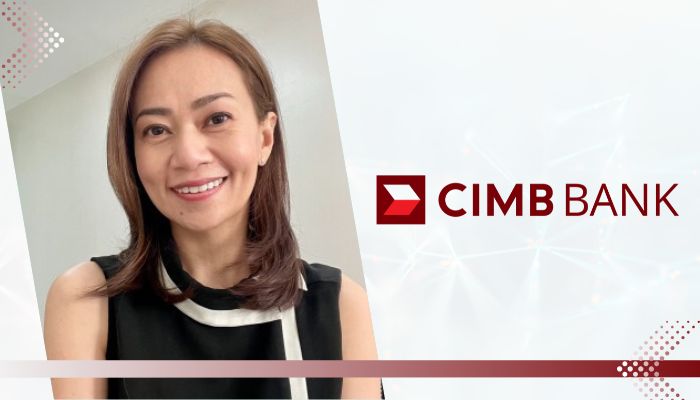
Hence, CIMB Bank Philippines’ newly appointed Head of Marketing Communications, Nikki Constantino, argues that one can actually “begin with the end in mind,” a seemingly transformative way to rearrange the not-so-linear ways of communicating.
Having previously held roles at AXA Philippines, China Bank Philippines, Citi, and Summit Media, Nikki’s new position now brings the challenge of staying competitive in the fast-evolving digital landscape.
In this MARKETECH APAC feature, we spoke with Nikki about how the new role pushes her to broaden her influence and lead both functions, and how communicating with empathy, in general, fuels her “audience-first” strategy.
Clarity, consistency, and the CIMB story
Nikki started by stating that CIMB Bank has a story to tell.
As a digital-only commercial bank that started in 2018, Nikki shared that it began by addressing the “pain points” that customers experienced with traditional banking.
This established a system with no long queues, paperwork, or the need to file leave from work just to make a bank transaction.
“This enabled a lot of Filipinos who were previously unbanked to open a bank account for the first time, and to take out a loan for the first time from a legitimate financial institution—not loan sharks,” Nikki shared.
Since then, she continued, the bank has enabled financial access for more Filipinos, calling this “a win for our countrymen.” If told properly, she added, this story could “be one of the important instruments to help drive growth for the bank.”
Beyond this story, Nikki had her own.
She was at the time the Head of Corporate Communications of the bank when the role of Head of Marketing Communications was created.
“I find myself in an interesting position since I am combining corporate communications and marketing communications in my new role. These two functions each have their own objectives and desired outcomes, and it’s exciting that I can orchestrate both from the same stance.”
With over 25 years of experience in corporate and marketing communications, Nikki outlined three of her key strategic priorities for the brand.
“First, I think it starts with being very clear on who we are and what we stand for, and making sure that it comes through consistently everywhere.”
Currently, she shared, a brand can be easily fragmented depending on the channel or the campaign. Nikki highlighted that tightening this is essential. “So whether a customer sees an ad, reads a PR article, or opens the app, it all feels like it’s coming from the same place. That kind of consistency is what builds familiarity and, eventually, trust.”
At the same time, she continued, it helps to communicate closely with what the business is trying to achieve.
“It’s not just about putting out good content—it’s about making sure that what we do actually helps move the needle, whether that’s bringing in new customers, keeping them engaged, or deepening relationships.”
She also placed strong emphasis on understanding customers, highlighting that while it sounds simple, it is where “things fall short.”
“Before we say anything, we need to know who we’re talking to and what matters to them. From there, it’s about simplifying our messages and making sure the value is clear, relevant, and easy to grasp. If people don’t immediately see why something matters to them, we lose them.”
Underpinning all of these strategies, Nikki underscored trust.
“In banking, that’s non-negotiable. So it’s about being clear, honest, and timely in how we communicate. Over time, those small but consistent actions are what build credibility and strengthen the brand.”
The classic that is clear and concise
Communicating for a brand is one thing, but building a culture that innovates the brand in the fintech space is another.
In the same regard, Nikki emphasised that packaging a message that is new and attractive to the audience is one thing, but it is another to take the classic, but practical role of simply being clear and concise.
“A lot of the new tools we all use and enjoy have one thing in common: they made something simpler for us, not more complicated. So if someone were to say, ‘your mobile banking app is so basic,’ I would take that as a compliment,” she said.
According to Nikki, the same principle applies to communications.
“This is not me being risk-averse or eschewing frivolity in the work—this so-called bells and whistles or whatever is trending,” she clarified.
Nikki continued, “I believe people are more likely to take action if the message is clear, and I believe there is a junction where creativity and clarity meet. I’d go for clear and concise all the time. It’s timeless.”
Adding to this, she emphasised her belief that leaders must remain steady over time, rather than being swept along by the “ebb and flow of the milieu.” This highlights her priority to remain constant in a continuously evolving and fast-paced fintech landscape.
When asked about the challenges she foresees and the accompanying opportunities for the brand, Nikki highlighted one goal: to materialise a strategic venture for physical and traditional advertising for CIMB.
“As a digital-only bank, CIMB does not have a brick-and-mortar branch in the Philippines. While one may argue that being digital—or having only the mobile app as a touchpoint—is an advantage in that it allows for ubiquitous presence, unfortunately, a lot of customers still have the disposition of ‘I’ll believe it when I see it.’ And it’s valid,” Nikki shared.
With this, she admitted to feeling like they are “losing a lot of marketing opportunities.”
“We also very rarely go into merchandising. But so much has to be said about this ‘conventional’ way of marketing: high brand recency is considered one of the strongest predictors of future purchase behaviour, and brand recall is crucial for building customer loyalty and staying competitive in the market,” she stated.
Nikki also underscored that operating strictly within the parameters of the digital realm when it comes to marketing is often “not enough.”
With this, her focus for the incoming year can be summed up as delving into communication that is “more personal and relevant.”
“Something with more heart. But to do that properly, we can’t just guess—we need to actually understand our customers better. So a big part of my time would go into building that foundation: getting deeper insights into who they are, what they truly need, and how they behave,” Nikki explained.
This, once translated, could result in less generic bank messaging and something that “actually speaks” to the audience.
From there, Nikki shared that it will be more about consistency—one that builds trust through clear, simple, and customer-first messaging across all touchpoints.
“Long-term success for me is pretty straightforward: if I can walk up to a random Filipino on the street, ask if they know CIMB, and they say yes (and more importantly, that it’s a good bank), then I know we’re doing the job right.”
In many ways, Nikki’s approach brings the conversation back to where it began: while communication may not follow a fixed structure, its effectiveness ultimately hinges on intent. By choosing to “begin with the end in mind,” she reframes communication not as a linear process, but as a deliberate act of aligning purpose, message, and audience.
Whether through simplifying complexity, building trust, or making the brand more tangible to Filipinos, her strategy underscores a constant truth: clarity and empathy are not just techniques, but the very outcomes communicators must design for from the start.






![[Featured Image] AI Visibility Forum 2026](https://marketech-apac.com/wp-content/uploads/2026/04/Featured-Image-AI-Visibility-Forum-2026.png)

![[Report] Gemini SEA Users](https://marketech-apac.com/wp-content/uploads/2026/07/Report-Gemini-SEA-Users.webp)