

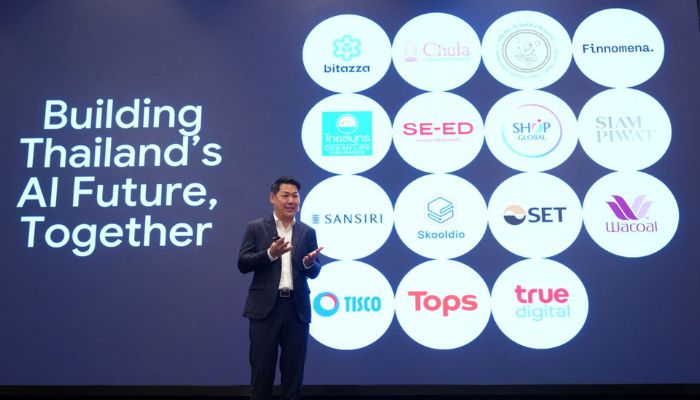
Bangkok, Thailand – Google Cloud has introduced PanyaThAI, a new transformation program aimed at helping Thai organisations build and scale enterprise-grade agentic AI solutions. The initiative, announced in Bangkok on Nov. 26, begins with 15 charter members from sectors including financial services, retail, education, manufacturing, media, and real estate.
The founding participants are Bitazza, Chulalongkorn University, Dhipaya Group Holdings, Finnomena, Ocean Life Insurance, SE-Education (SE-ED), Shop Global E-Commerce Company Limited, Siam Piwat, Sansiri, Skooldio, the Stock Exchange of Thailand, Thai Wacoal, TISCO Financial Group, TOPS, and True Digital Group.
According to Google Cloud, the program’s name, “PanyaThAI” (ปัญญาไท), plays on the Thai words for “wisdom” and “Thai,” reflecting its goal of combining local expertise with advanced AI tools. The company said the initiative aligns with the member organisations’ commitment to responsible AI adoption.
Citing research from consultancy Public First, Google Cloud noted that improved AI adoption could add an estimated THB 730 billion (US$21 billion) to Thailand’s economy by 2030. The research pointed to three major barriers for organisations: the need for more reliable AI outputs, AI-ready data sources, and a skilled workforce.
Annop Siritikul, country director for Thailand at Google Cloud, said, “Globally, more than half of surveyed executives reported six to 10% revenue growth from putting enterprise AI solutions into the hands of their teams and the people they serve. Their organisations are now channeling at least half of their AI budgets toward a unified agentic platform that will serve as the core engine for redesigning operational processes and strengthening their market leadership.”
He added: “More specifically, companies that have embraced AI from Google Cloud have transcended ‘pilot purgatory.’ They have achieved an average return on investment (ROI) of 727% in three years, with a ‘payback period’ of eight months, reinforcing that not all AI technology providers and transformation approaches are equal. Through PanyaThAI, we’re bringing a proven blueprint to organisations, providing them with full-stack AI services and essential training and expertise. Our ambition is to help them foster a workforce that’s ‘bilingual’ in their domain and AI, accelerating their ability to solve complex challenges and drive consistent ROI from AI. We’re seeing strong interest in this program and look forward to welcoming and supporting more organisations beyond the initial 15.”
PanyaThAI is based on Google’s full-stack AI approach, including its infrastructure, research from Google DeepMind, and models such as Veo 3.1, Gemini 3, Gemini 3 Pro Image (known as Nano Banana Pro), and Gemini 2.5 Computer Use. Organisations will receive support in building solutions using tools like Vertex AI, Gemini Enterprise, and Google Workspace.
Consulting and implementation partners include Accenture, Deloitte, Digithun Worldwide, HoriXonT8, MFEC, NTT DATA, Skooldio, and Tridorian. NTT DATA plans to certify 300 additional local Google Cloud specialists in data analytics, AI, cybersecurity, and application modernisation.
Through the program, participants will co-develop AI roadmaps, prioritise use cases, build open and interoperable AI solutions, establish governance mechanisms rooted in responsible AI principles, define performance metrics, and upskill employees using platforms such as Google Skills and ChaiyoGCP.
During the launch event, several charter members showcased early projects developed through PanyaThAI.
SE-Education (SE-ED) highlighted its collaboration with Digithun Worldwide to integrate a generative AI-powered semantic search agent into its e-marketplace platform. The solution aims to enhance book and content discovery by understanding user queries conceptually instead of relying on keyword matching.
Niwat Chatawittayakul, managing director at Digithun Worldwide, said, “We partnered with SE-ED to successfully transform their platform from a traditional e-commerce website into a comprehensive e-marketplace through application modernisation on Google Cloud. This architectural overhaul establishes the high-performance digital foundation required to support complex AI workflows. Building on this, we designed SE-ED’s AI search agent to understand concepts, not just keywords. It starts by using Google’s Gemini Embeddings model to curate a selection of products that are conceptually relevant to the user’s query—for instance, ‘The Lord of the Rings’ novels in response to ‘a hero destroying a powerful ring in a volcano,’ even if the search terms aren’t in product descriptions. This process is grounded in SE-ED’s catalog to ensure the agent never recommends ‘made-up’ products. The selection is then handed off to the Gemini 2.5 Flash model, which applies deep reasoning to rank and organise the order in which the products are presented, delivering final search results aligned with the user’s true intent.”
Rungkan Paisitpanichtrakul, managing director at SE-Education, commented, “We’ve established an omnichannel ecosystem to foster intellectual curiosity and a reading culture across the nation. As the market leader, SE-ED is committed to pioneering a new era where an intelligent AI agent serves as the ultimate personal reading assistant for every Thai. Building on this early success, we’re looking to embed more helpful and high-value AI capabilities into this platform, as well as our SE-ED Reader and e-Library by SE-ED mobile apps.”
Passpunnee Mahayos, head of digital business at SE-Education, stated, “By harnessing the same powerful AI components that underpin Google Search, our AI search agent helps e-marketplace users discover highly relevant resources faster and with greater precision. This enhanced experience has proven that faster discovery leads directly to purchases—driving organic conversion rates from 12% to a remarkable 27%, while successfully reducing bounce rates to 10% and cart abandonment to just 6%.”
Thai Wacoal presented an initiative to embed a creative AI agent into its value chain. Developed with Tridorian and built on Google’s generative media models, the tool is designed to reduce reliance on product photoshoots by generating photorealistic images and videos for all color variations from a single base photoshoot.
Andhika X, chief revenue officer at Tridorian, noted, “Google’s generative media models have mastered the physics of fabric and the 3D geometry of the human body, preserving lighting, folds, and texture while modifying pixel color data. We’ve also grounded the models’ outputs in Thai Wacoal’s database of color swatches and standards. This ensures the agent doesn’t ‘guess’ a shade but retrieves exact manufacturing specifications, creating a verifiable ‘digital twin’ that matches the actual product. Our solution will empower Thai Wacoal to launch and monetise multi-color apparel collections on its e-commerce platforms with minimal delay, translating high-speed, high-fidelity visual asset creation into revenue opportunities.”
Supranee Auiyasathian, deputy director of digital business for Wacoal at Thai Wacoal, said, “When our creative agent goes live in Q1 2026, it will do more than just solve our photoshoot predicament and accelerate time to market; it will offer the opportunity for Thai Wacoal to shift toward a high-mix, low-volume or made-to-order manufacturing model, where production can be tied directly to actual customer engagement and demand. Across our portfolio, we have already implemented other AI innovations, including Google Cloud’s Virtual Try-On capabilities, to unlock new strategic advantages through digital realism and mass customisation.”







![[Campaign] Canva Japan Anime](https://marketech-apac.com/wp-content/uploads/2026/06/Campaign-Canva-Japan-Anime.jpg)