

Out-of-home (OOH) advertising across APAC is undergoing a structural shift, moving from a scale-driven awareness channel to a data-enabled, performance-oriented medium.
Markets such as China, Australia, Singapore, and Indonesia are seeing accelerated investment in digital out-of-home (DOOH), programmatic buying, and dynamic creative optimisation, allowing brands to sync messaging with time of day, weather, location data, and even retail triggers.
For marketers, this evolution means OOH is no longer just a top-funnel branding play—it is increasingly measurable, attributable, and integrated with mobile, social, and e-commerce ecosystems.
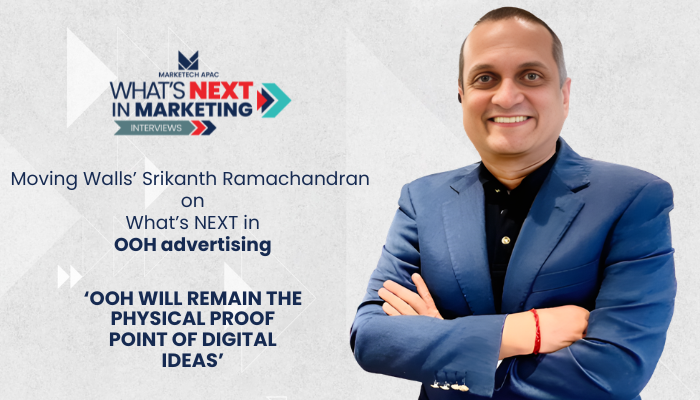
In our latest What’s NEXT in Marketing interview, we sat down with Srikanth Ramachandran, founder and group CEO at Moving Walls as he discussed the future of OOH advertising, and what trends should marketers consider when implementing their OOH strategies.
The smarter approach to datasets in OOH
When asked what types of data will matter most for OOH effectiveness moving forward, Srikanth advises to stop choosing one dataset, adding that the real problem isn’t missing data–it’s false positives. Moreover, he notes that the industry’s habit of debating mobility versus attention versus commerce is the wrong conversation to have.
“Mobility data alone can look impressive: high traffic, dense commuter corridors, massive reach. But we’ve analysed campaigns where mobility-only planning delivered 22% lower conversion rates compared to campaigns that layered exposure validation and commerce signals. High movement does not equal high impact,” he explains.
Speaking of attention data, he adds, “Attention data alone tells you visibility occurred, but not whether it influenced behaviour. Commerce data alone tells you sales happened, but not whether OOH drove them.”
For him, the smarter approach is to eliminate false positives by connecting signals:
- Mobility to understand movement patterns
- Attention to validate exposure quality
- Commerce to confirm behavioural change
“When these datasets operate in isolation, budgets leak. When connected, waste drops,” he remarked.
In one instance for a retail campaign across Southeast Asia, integrating mobility, attention validation, and transaction datasets reduced wasted impressions by 18%, improved store visit lift by 12%, and increased return on ad spend by 9% versus a mobility-only plan.
“Here’s the contrarian truth: more data does not automatically improve performance. Poorly connected data creates overconfidence. Precision without validation scales mistakes faster,” he added.
Using Moving Walls Science as an example, Srikanth explains that rather than stacking dashboards, the platform models incrementality, isolating which exposures actually moved outcomes. For him, the goal isn’t more signals, it’s more of a cleaner causality.
“And that causality matters even more as we move into sustainability and procurement scrutiny because data decisions now affect not just performance, but responsibility,” he said.
Creative thinking evolution alongside OOH’s evolution
In this day and age, Srikanth highlights how context now carries as much weight as content.
“OOH works because it exists inside lived experience. Morning commuters process information differently from evening commuters. Cognitive load shifts. Emotional state shifts. Intent shifts,” he says.
For him, as screens become smarter, creative strategy is moving from presence to precision.
“We are not personalising OOH to individuals. We are aligning it with circumstance,” he added.
Part of that evolution in OOH creatively is through dynamic triggers–traffic density, weather shifts, prayer times, and retail proximity–whichallow a stable brand idea to flex intelligently. If anything, the creative core remains consistent, and the contextual layer adapts.
“Repetition still builds memory. But identical repetition decays impact. Our post-campaign analysis shows recall stabilises when dynamic contextual elements are introduced after the third exposure, instead of running a fixed creative throughout,” he added.
Moreover, the psychological dimension is also under-discussed, with cities saturated with high-brightness LED screens, visual overstimulation reducing processing depth.
“E-ink and low-glare formats create what I call “contrast by restraint.” The calmness lowers cognitive resistance. People do not feel interrupted; they feel oriented. That subtle shift increases dwell time and message absorption in environments overwhelmed by motion and glare,” he explained.
He summarised all of these by saying, “Calm cuts through chaos. This is not an aesthetic preference. It is behavioural design.”
How sustainability will reshape OOH
Amid all of these developments in OOH advertising, Srikanth also highlighted how sustainability is now a survival metric, and that efficiency alone is not transformation.
“Modern LED screens consume 30–40% less energy than early-generation digital panels, according to manufacturer lifecycle assessments by various suppliers. Efficiency gains are measurable, not aspirational,” he explains.
For instance, e-ink and low-power displays challenge the assumption that brighter is better. They reduce energy draw dramatically, often operating at a fraction of traditional digital consumption–and more importantly, they shift perception.
Meanwhile, in premium retail districts, advertisers adopting low-glare formats have reported stronger brand association with sustainability and design sophistication, an intangible lift that influences purchase intent.
“The “green premium” narrative is outdated. When properly evaluated, sustainable formats often reduce long-term operating costs and enhance contextual effectiveness. The issue is not cost inflation. It is outdated to buy frameworks,” he said.
With procurement teams now demanding carbon reporting alongside CPMs, Srikanth laid out details on how buyers can integrate it immediately:
- Request emissions-per-thousand-impressions data from media owners.
- Standardise reporting across formats before final allocation.
- Include carbon intensity as a weighted variable in RFP scoring.
An example of this move is how Moving Walls, through its partnership with Cedara, has its campaigns executed via Moving Walls Science generate carbon reporting alongside performance metrics.
Moreover, its framework that they developed with the Asian School of Business feeds directly into this measurement layer, enabling apples-to-apples comparison across digital, static, and hybrid formats within the same dashboard.
“This is where alignment matters. Sustainability data cannot sit in a PDF appendix. It must live inside the planning system. Media owners that cannot quantify emissions will struggle to attract multinational budgets within five years,” he said.
Rethinking the role of OOH amidst short retention periods
Srikanth has remarked that OOH is a demand amplifier, not an awareness line item; compared to digital-only performance campaigns which often optimise toward the same high-intent users repeatedly.
“Auction algorithms reward recency and prior engagement. That creates diminishing marginal returns. OOH interrupts that cycle by expanding mental availability offline, which feeds incremental branded search and lowers digital acquisition costs,” he explains.
For him,tThe mechanism is measurable by the following:
- Physical exposure increases branded search volume.
- Higher branded search improves click-through rates.
- Improved CTR lowers cost-per-acquisition in auction environments.
“In controlled geo-tests where OOH exposure zones were matched against non-exposed zones, we observed measurable uplifts in branded search queries and improved mobile engagement rates within exposed districts,” Srikanth added.
As an example, a 29-day Ramadan transit campaign for a ready-to-drink FMCG brand reached 11.9 million unique individuals, delivered 17.8 million impressions, achieved 95% ad recall, and generated double-digit lifts in brand awareness and purchase intent. Digital engagement rates rose in synchronised commuter corridors during the campaign window.
“Performance does not live in one channel. It lives in the interaction between channels,” he says.
Moreover, tools like Moving Walls Science integrate exposure modelling with commerce and digital signals to measure incrementality, not just correlation.
“That distinction matters in an era where every platform claims AI optimisation. AI without cross-channel causality is just automation,” he added.
The future–and success–of OOH advertising moving forward
When asked what success actually looks like for the OOH industry in the coming years, Srikanth said that commercial success means structural integration into performance media plans.
“AI-driven automation is already reducing planning friction. Independent programmatic benchmarks from PQ Media and Magna indicate automation can reduce manual planning cycles by up to 40%. That efficiency unlocks budget flexibility and shortens optimisation windows,” he explained.
Moreover, he noted that OOH must become as deployable as paid social, not as complex as traditional outdoor buying once was.
“Creatively, OOH will remain the physical proof point of digital ideas. Campaigns will increasingly launch online and culminate in public space, where visibility confers legitimacy,” he said.
He further added, “Culturally, OOH must operate as infrastructure. When unsold inventory supports SMEs, local entrepreneurs, or public initiatives, it strengthens economic ecosystems. Stronger local ecosystems drive sustained advertiser demand. Community visibility is not charity. It is long-term market building.”
He has also observed how the friction points are clear: fragmented standards, inconsistent carbon metrics, and siloed attribution models–and that alignment is not optional.
In addition to it, leadership in the next decade will look like this: fully measurable OOH inventory, real-time carbon reporting embedded in media plans, AI-driven incrementality modelling, and seamless activation between mobile and physical environments.
“OOH will not lead by being louder. It will lead by being provable,” he concluded.
***
For marketers across APAC, the story of OOH today is ultimately one of reinvention. What was once viewed primarily as a mass-reach branding channel has evolved into a dynamic, data-infused medium that mirrors the sophistication of digital.
As mobility patterns stabilise and consumer journeys blur between physical and digital touchpoints, the brands that win will be those that treat OOH not as a standalone format, but as a connective layer—linking awareness to action, and real-world presence to digital performance.











![[Report] Gemini SEA Users](https://marketech-apac.com/wp-content/uploads/2026/07/Report-Gemini-SEA-Users.webp)