
The entrance and the evolution of artificial intelligence in the marketing and advertising scene is something that has been the focal point of discussions in the industry, to the point leaders have polarised opinions on it. Whether you are on the side of going for its evolution or the peril it brings, AI in marketing has proven itself to be impactful, both in the conception and execution process in the industry.
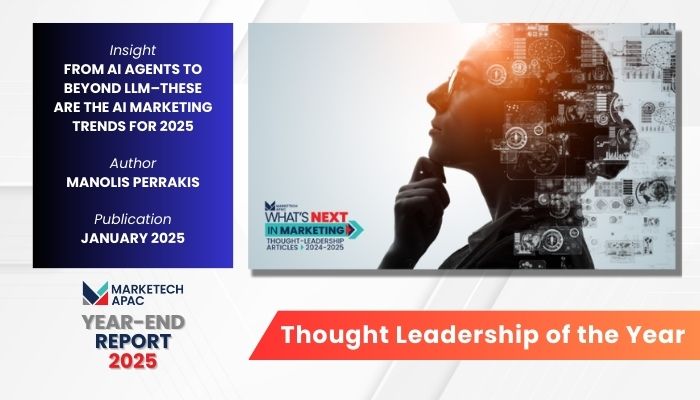
It is with this premise in mind that MARKETECH APAC published a byline titled What’s NEXT in Marketing: From AI agents to beyond LLM–these are AI marketing trends for 2025, which gave us the first look on what the industry can expect on the evolution of AI marketing this year. With the impact the piece had in terms of viewership and relevance, the piece has been recognised as our Thought Leadership of the Year.
To further delve into the insights shared on the piece–and other expectations we can expect in 2026–we recently spoke with Manolis Perrakis, Innovation Director at We Are Social Singapore–the byline’s author–as he discusses the evolution of these AI marketing trends, and how marketers can adapt to these changes.
AI agents: friend or foe of the creative process?
In the piece, Manolis highlights how with significant cloud infrastructure being developed to support voice-to-voice AI agents across various scenarios, the industry should expect more of them used for customer service, development, language translation and in gaming and entertainment.
Looking back at this, he personally reflects that his personal favorite use of agents and AI workflows is in automating the mundane, repetitive, and complex tasks, effectively removing friction from the creative process.
“Humans are inherently creative, there is nothing that will take that away from us. While many aspects of production will inevitably be automated, creative teams are finding exciting new avenues to implement these technologies for creating content that goes far beyond what we have seen before,” he said.
He goes on to mention how tools like Nano Banana Pro, Veo 3.1, Sora 2, and Flux 2 have empowered creatives in order to truly flourish creativity in the industry. However, there is still a caveat to this, requiring human creativity in the process at all.
“However, I’m not dismissive of algorithmically generated content. Even for automation, the human element is non-negotiable. The orchestration of agents, the initial strategic spark, and the final polish are still tasks that require a creative mind,” he added.
Looking forward, Manolis notes that he foresee that the industry will start seeing a surge in purpose built automations, with the added distinction that these are not replacements for human talent but amplifiers of creativity. Moreover, there will also be widespread adoption of applications like Gemini Gems and OpenAI GPTs, alongside more sophisticated methodologies like n8n nodes and vibecoded applications.
“These will serve as dedicated research agents, brainstorming assistants, and visualisation workflows that handle the heavy lifting so we can focus on the craft. This doesn’t mean there will be no creative problems to solve, but instead, we will be empowered to tackle even more challenging and complex problems with the help of AI,” he explained.
The evolution of GenAI content, from images to 3D content
Manolis pointed out in his byline that AI generated content is going nowhere in 2025 – it is only set to become more prolific across all mediums. Beyond just text and image, he noted that we will see video and audio generation technology continue to evolve, improving quality and consistency.
When asked how this evolution will impact GenAI content in the future, he stated that the impact will be monumental, and that we are already seeing the friction disappear between a creative thought and a video or image output.
“It is evident in all steps of the creative process, from pitches to ideation and content creation, that these technologies are transforming our communication skills and the way we convey ideas to clients and consumers. During the pitching phase, ideas are now transformed into production-ready films and visuals that convey creative intent like never before,” he said.
At the moment, Manolis notes how we are witnessing image, 3D, and video AI models being used in unison within creative workflows to deliver both traditional and experiential content. “The ability to generate high-fidelity assets and environments on the fly allows us to prototype and build immersive experiences at a speed that was previously impossible,” he said.
But the real revolution, according to him, will arrive when World Models, like Google’s Genie 3, become available. For Manolis, World Models represent the pinnacle of GenAI, where image, video, and 3D converge into real-time content generation that will fundamentally revolutionise how the public creates and consumes content.
“Imagine, in the foreseeable future, being able to relive your past holidays by stepping into a fully interactive 3D world generated from just a single picture. This is not just a technological marvel, it is an inspiring world-building technology. We will soon be able to pause a movie and explore the scene as if we were actually there, or see brands creating magical, hyper-personalised experiences that you can dive into and interact with in VR,” he remarked.
The ethics of AI in marketing–and what lies ahead
When asked about how can creatives ensure that AI-driven creativity remains ethical and transparent, Manolis argues that most creatives are not concerned about the origin of datasets or training data, not because they don’t care, but because it often goes beyond their technical bandwidth and visibility.
“Creatives have faced a predicament over the past three years: they must constantly upskill on a new ecosystem of tools, while simultaneously trying to be cautious about compliance,” he noted.
On the flip side, Manolis explained that we now have AI companies that only provide high-level information and frequently obfuscate proprietary datasets, resulting in lawsuits from the movie and music industries against foundational models.
“Given the ambiguity and complexity of the current AI legal landscape, we cannot expect creatives to be the sole judges of which technology is ethically and legally sound. It is imperative that organisations that are using AI for creativity do their own due diligence to build a responsible AI framework that informs and advises their employees on the “Dos and Don’ts” of GenAI,” he explained.
Taking their work at We Are Social, for instance, Manolis says that they have clear guidelines provided by internal legal teams regarding which GenAI models are permissible, and specifically which models offer protection against legal claims from copyright holders.
In cases where a model doesn’t offer that protection, indemnification from clients is often needed for the model to be used.
“Until AI companies list all trained data transparently, it is best for creatives to stick to the permitted list of GenAI models provided by their organisation and work closely with internal legal teams to prevent future potential copyright issues,” he stated.
When asked on how close agencies are to using AI that can ideate campaign concepts autonomously, Manolis remarked about how it’s not about being close to using it fully but rather what percentage of agencies are already using AI to fully automate the generation of creative ideas. For him, while the number might still be quite low, this will be changing very soon.
“I personally believe there is a specific place for end-to-end automation, particularly for repetitive creative tasks or for providing “thought starters” to break a creative block. However, for high-level campaign concepts, AI is currently best used as a force multiplier for human strategy, not a replacement for it,” he concluded.
This recognition is based on Google Analytics results on the most-read stories of 2025, along with editorial validation on the significance of a leader’s contribution, campaign results, and overall impact.