
Every consumer has faced that moment in a grocery aisle, debating whether to choose Brand X or Brand Y. While it may seem like a simple decision, it often masks a deeper complexity—sometimes, both brands are owned by the same corporation. Yet, this reality doesn’t diminish the significance of that split-second choice. For marketers, the real value lies not just in the decision itself, but in understanding the motivations behind it.
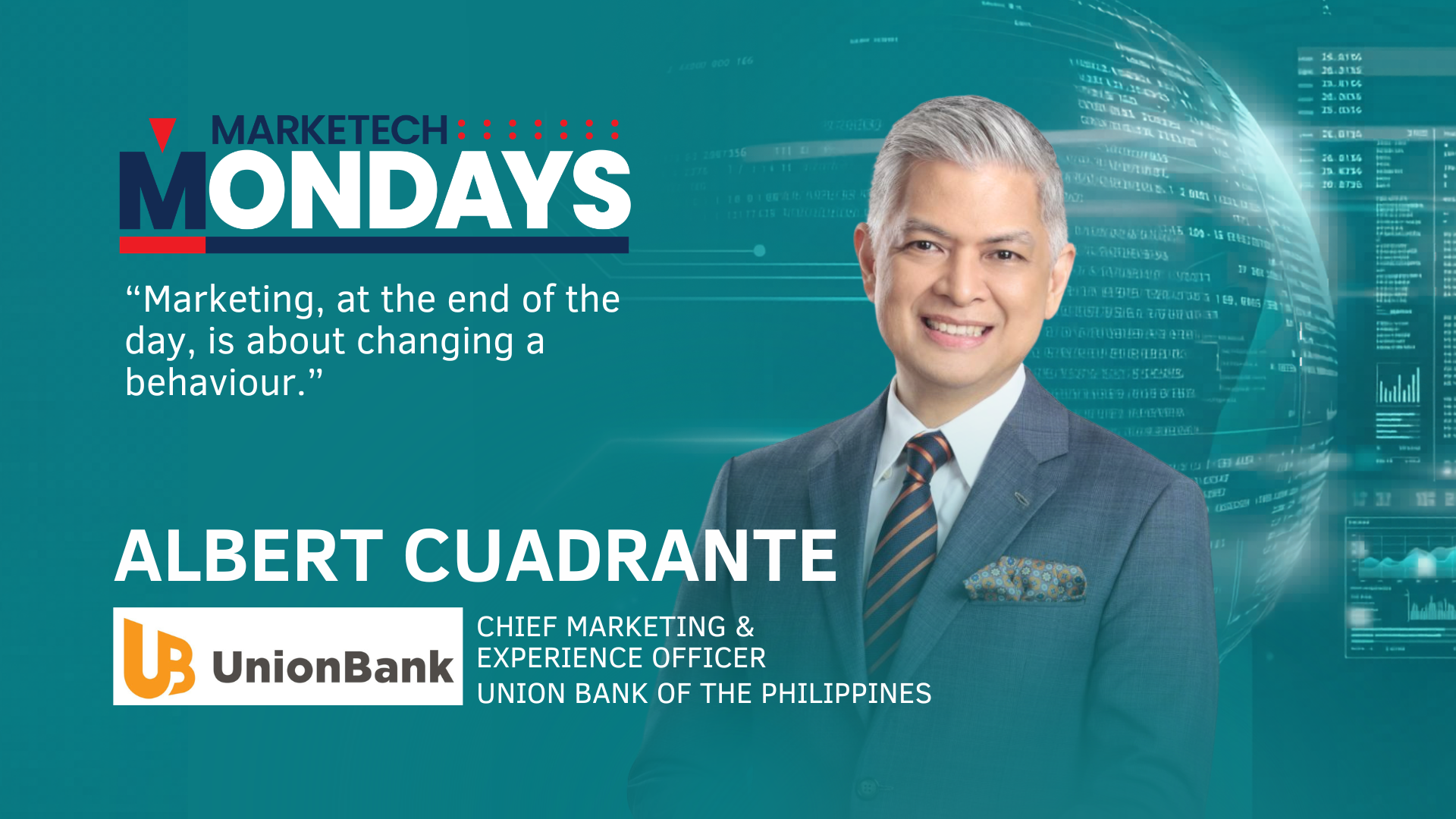
This is why, for marketers, decoding consumer behaviour is never a wasted effort. As Albert Cuadrante, Chief Marketing and Experience Officer at Union Bank of the Philippines, emphasises: at its core, marketing is about changing behaviours.
In this MARKETECH Mondays feature, we sat down with Albert Cuadrante to explore his passion for marketing, his formative years at P&G, and the disciplines that have shaped him into one of the country’s most formidable marketers.
The Psyche of Choice
Albert’s fascination with marketing began in college, inspired by professors who introduced him to brand management and market research. “What really attracted me to the discipline is understanding the reasons behind people’s behaviours—why do people choose one product over another? Sometimes, people make seemingly irrational choices, like why some more expensive products outsell their cheaper alternatives, and decoding the reasons is fascinating,” he reflects.
He soon realised that marketing sits at the intersection of behaviours and the mindsets that drive them. “I learned this in my Brand Management class, so I researched who pioneered Brand Management as a discipline. When I found out it was Procter & Gamble, I aspired to work there—and eventually did,” Albert recalls.
His role at P&G was demanding, but the long hours were essential to meeting the company’s high standards. After nearly six years, Albert felt validated in his career choice. While marketing brands like Tide and Pampers required different approaches, the real value was in understanding diverse consumer segments and industries.
These foundational years were not without challenges and sacrifices. Albert describes working on Tide as one of the most difficult assignments of his career, calling it “very competitive.” He recalls observing people do their laundry firsthand, believing that genuine insights come from direct observation, not just desk research.
“For me, a campaign must be driven by a core insight—something you can’t gain by staying behind a desk. Marketing, at the end of the day, is about changing behaviour. Whether it’s encouraging more consumption or switching brands, it’s about influencing what people do,” he explains.
Albert carried this principle throughout his career, emphasising the importance of thorough consumer analysis and interacting and listening to them firsthand. “The discipline I learned in analysing the business and extracting insights remains foundational for me, even today.”
When asked about a campaign he’s most proud of, Albert recalls his time at Jollibee. “When I handled the Jollibee brand, the big problem then was…it didn’t have a strong affinity with teenagers because teenagers felt that Jollibee was a kiddie brand…We used a product which we felt had a higher chance of relevance with teens, which was the burger, as the lead for the campaign to win over teens to Jollibee and it worked! That year we were finally part of the top brands Pinoy teens loved.”
From Mentors to Modern Realities
Albert credits three former bosses for shaping his professional DNA. From his first boss, he received his share of revision notes—tedious at the time, but invaluable in making him data-driven. His next boss taught him to “see the forest for the trees,” fostering a big-picture mindset. The third instilled a numbers-oriented discipline: every idea must ultimately contribute to business revenues and profits.
“You can buy market share with promotions, but you can’t sustain a business without revenues and profits as a result of being the preferred brand as a result of a compelling value proposition,” Albert notes.
Beyond his direct supervisors, Albert was inspired by the late Department of Tourism Secretary Ramon Jimenez Jr., whom he admired for his ability to read people and articulate insights. “That’s why the ‘It’s More Fun in the Philippines’ campaign was so brilliant. Even now, people remember it—it’s the most memorable DOT campaign,” Albert shares.
Navigating the Digital Pivot
As the economy grows more challenging, marketing leaders must ensure every action translates to business results. “For any marketing leader, it’s about bang for the buck. It’s easier to make things happen with a huge budget, but it requires real Marketing skill to win with less,” Albert observes.
He describes the pandemic as a “reboot” that challenged everything he knew—a period that forced him to “throw his book out the window.” Yet, he found opportunity in crisis: “Don’t let a good crisis go to waste. There are always opportunities in what seems impossible.”
This mindset found a home at UnionBank, which committed to digitalisation as early as 2016. “UnionBank embraced digitalisation early on, which attracted me because it’s not a typical legacy bank,” he says. While others expanded their branch networks, UnionBank maintained its footprint, fully committing to digital banking.
For Albert, digitalisation was just the first step. Today, the bank leads in AI integration. “AI is permeating our operations. The sooner you embrace and master it, the less threatening it becomes—and it can even be a competitive advantage.”
Albert is optimistic about the future. “Everything in our pipeline aims to make customers realise what’s possible with digital banking,” he says.
An Enabler’s Approach to Leadership
Albert often shares his insights with aspiring marketers, emphasising that technology cannot replace human proximity. “AI can make sense of what’s online, but staying close to the customer offline is irreplaceable,” he asserts.
He believes that if marketers lose touch with people, their work will lose relevance. “You have to keep pace with behavioural changes and, ideally, anticipate them.”
Asked to describe his journey in one word, Albert chooses “transformational.” He’s drawn to brands and companies at the forefront of change, and his leadership philosophy centres on enabling others. “I like drawing solutions out of people, helping them realise their capabilities. I enjoy working with brilliant people—I don’t have a monopoly on knowledge.”
In the end, what seems like a simple choice in a grocery aisle is anything but mindless. It’s shaped by insight and observation. Albert’s journey reflects this truth: behind every decision lies a mindset waiting to be understood, influenced, and reimagined. By staying close to people, the reasons behind their choices will always reveal the way forward.