
The digital economy continues to grow exponentially in Southeast Asia, including in Malaysia where a blend of evolving consumer behaviour and technologies have allowed for new ways for Malaysians to address daily needs, from online shopping to travel bookings. Such growth is also equivalent to valuable signals that marketers can take the opportunity to connect organically through relevant brand experiences.
Despite all of this, many marketers are still stuck on the same online channels to begin tapping into these customer journeys, with these differences causing fragmentation of data for marketers. The question is: what channels can marketers use that not only record unified customer journeys for their marketing strategies but also utilise both online and offline transactions to properly contextualise their campaigns as well?
With that in mind, MARKETECH APAC recently spoke with Wong Chee Mun, Head, Merchant Services (Business) at TNG Digital, to discuss why financial wallets like TNG eWallet not only serve its traditional function for accessible finance needs of Malaysians but also as an avenue for brands to connect with active users who aim for seamless experiences, whether for travel or shopping.
Addressing value–and misconception–of financial wallets for marketers
In an age where data is ‘oil’ for brands, Wong highlights that user behaviour is one of the strongest indicators of intent for marketers. Citing the status quo in Malaysia, he notes that digital wallets are used multiple times a day, whether it’s paying for food, browsing nearby merchants, topping up, or planning travel.
“When brands tap into these moments, they’re not guessing what users might want; they’re aligning messages with what users are already doing, which naturally leads to stronger relevance and more effective advertising outcomes.”
He also addressed a common misconception for financial wallets, wherein marketers view financial or super-app platforms being only suitable for basic transactions or lower-funnel advertising.
“Many marketers still view platforms like TNG eWallet as just payment tools or social apps, overlooking their broader ecosystem value and how deeply they are embedded in daily life,” he added.
Wong also noted, “There is also a belief that super apps struggle to retain users or generate meaningful engagement beyond transactions, when in reality users interact with them frequently through high-intent behaviours such as payments, rewards, discovery, and travel planning. It is the depth and context of these interactions, not just screen time, that create strong advertising opportunities.”
Given how eWallet usage has overtaken cards in transaction volume and value, Wong said that these platforms have become part of everyday lifestyles, enabling brands to engage consumers in natural, timely, and relevant moments rather than interruptive ways.
Simplifying media planning through financial wallets
Wong acknowledges that as consumer journeys today are fragmented across platforms, devices, and moments; financial wallets like TNG eWallet help brands connect better with Malaysians who have diverse behaviour when using the app.
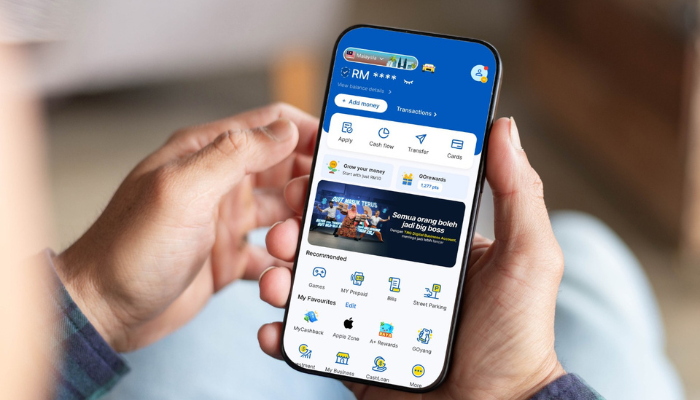
“TNG eWallet helps simplify this complexity by connecting brands to more than 25 million verified Malaysians who use the app daily – not only for domestic payments, but also for cross-border QR payments, travel planning, and lifestyle services,” he said.
Within a single ecosystem, TNG eWallet users can book flights, purchase travel insurance, submit arrival cards, and spend overseas using the TNG eWallet Visa Travel Card with unlimited cashback.
Speaking about how this ecosystem will help marketers, Wong says, “This allows brands to engage consumers across both local and international moments, from everyday spending to travel intent, without relying on disconnected channels. As a result, media planning becomes more cohesive, with consistent messaging anchored in real, high-frequency user behaviours.”
Another stand-out feature that also illustrates the value of TNG eWallet for marketers is its ‘Near Me’ feature, where it surfaces nearby dining options at that exact moment when users are searching for choices to eat nearby by combining location, trusted community reviews from verified transactions, and relevant deals.
“By embedding discovery directly into everyday financial behaviour, TNG eWallet reduces journey fragmentation and enables brands to reach consumers naturally, contextually, and at scale.”
Balancing personalisation with user trust
As a regulated financial platform, TNG eWallet operates strict data governance, regulatory compliance, and internal controls which ensure user trust and privacy are safeguarded at every stage.
With that in mind, Wong shares how the digital wallet’s ad solutions help brands create personalised experiences whilst instilling user trust during the process.
“TNG eWallet Ads Solutions balances personalisation with user trust by design, through a privacy-first, segment-based approach to targeting. We do not share individual users’ personal or transactional data with advertisers. Instead, targeting is built on aggregated and anonymised behavioural signals within the platform, such as spending categories or in-app engagement patterns, allowing brands to reach relevant audiences without access to personal identifiers or transaction-level details,” he explained.
Much like how there is a continued rise of retail media networks (RMNs) that retail brands use to target customers at stages, TNG eWallet Ad Solution’s status as a Financial Media Network also relies on enabling targeting at the segment level, not the individual level.
“This allows brands to align their messages with real user intent, whether around dining, travel, or everyday spending, while ensuring users’ data remains secure and protected within TNG Digital’s systems,” he said.
Wong also added, “Equally important, ads are designed to be contextual and non-intrusive, appearing naturally within existing user journeys such as discovery, rewards, or payments. Because messaging aligns with what users are already doing in the app, it enhances relevance without disrupting the experience.”
How TNG eWallet can complement your 2026 campaign planning
Looking back this year, Wong says one of the biggest lessons from 2025 is that digital signals alone are no longer enough. For them, online engagement tells part of the story, but real consumer behaviour happens when people spend, especially offline.
“As a Financial Media Network, TNG eWallet allows marketers to understand user behaviour across both online and offline transactions, offering a far more grounded view of how consumers live, choose, and purchase.”
Wong added, “This ability to connect digital engagement with real-world spending creates more robust data signals, sharper insights, and better decision-making. It moves marketing from inferred intent to observed behaviour.”
He also noted that another clear takeaway from 2025 is the growing value of trusted, first-party platforms as signal loss accelerates and privacy expectations rise. Platforms much like the TNG eWallet provide scale, frequency, and accountability – within a regulated ecosystem, allowing brands to plan with confidence rather than assumptions.
“As marketers look toward 2026, those who anchor their strategies in platforms that reflect real life, not just online activity, will be better positioned to drive relevance, effectiveness, and long-term growth.”
***
Ultimately, financial wallets like TNG eWallet are becoming more than just payment tools — they are evolving into powerful marketing platforms. With their ability to capture real-time transaction data, enable personalised offers, and connect seamlessly across online and offline touchpoints, wallets give marketers a clearer line of sight into consumer behaviour and intent.
When used responsibly and creatively, they allow brands to move from broad messaging to meaningful, context-driven engagement, turning everyday payments into moments of relevance, loyalty, and long-term brand value.