
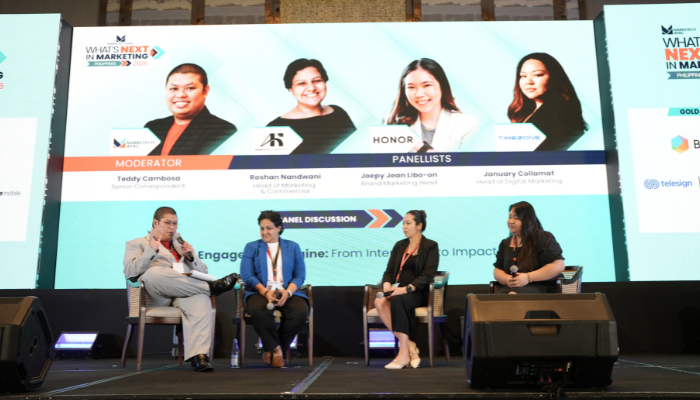
Manila, Philippines – What does it take to transform everyday interactions into tangible business results? That question anchored the panel discussion “The Engagement Engine: From Interaction to Impact” at the What’s NEXT in Marketing: Philippines 2026 conference, where marketing leaders examined the evolving mechanics of engagement in today’s digital ecosystem.
From connecting social conversations to seamless omnichannel pathways, to leveraging real-time data and cultural cues for timely engagement, the session–featuring Roshan Nandwani, Head of Marketing at Ayala Land Hospitality; Joepy Jean Libo-on, Brand Marketing Head at HONOR Philippines; and January Collamat, Head of Digital Marketing at Timezone Philippines, highlighted how brands can design strategies that not only capture attention but convert it into meaningful and scalable impact.
Turning customer engagement into real-world action
When first asked how a hospitality brand like Ayala Land Hospitality ensures that the luxury portrayed in their digital channels matches the physical one, Roshan shares that it all boils down to creating content that creates a ‘transformative feeling’, regardless of the destination being promoted online.
“What we do is we actually try to avoid gaps in all ways possible. The way we would want one to experience the conversion channel all the way to the actual product is that it just feels like it’s part of one story,” she said.
She also shared that customers feel great when they are outdoors, and that is the challenge they need to address when creating content about their properties.
“When you talk about high-end luxury, it’s making sure that the experience is end-to-end, it’s seamless. I think that’s the baseline. But the story has to be told across the entire journey. And for us, it should be that they all add on to the overall experience. So it’s not even that it leads up,” she said.
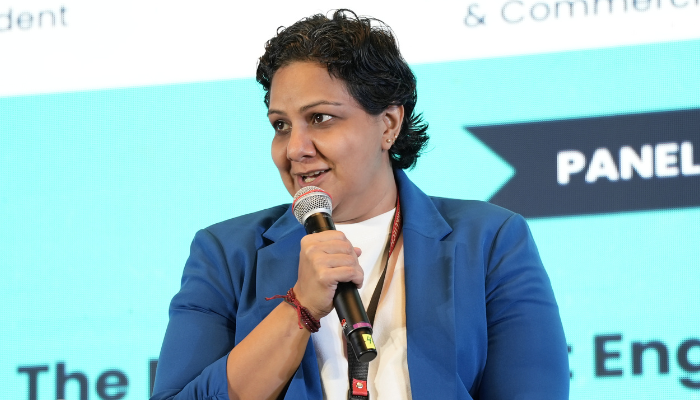
Roshan added, “It’s when you’re online, when you’re still in the pre-booking stage, when you’re excited, you’re opening yourself up to this journey that you’re about to take. And then the journey kind of closes itself, even after you leave the resort.”
Meanwhile, for a smartphone brand like HONOR, whose engagement is heavily driven by the rise of unboxing videos and online reviews, Joepy shares that the brand consistently maintains clear momentum in conversions as it navigates the challenge of converting customers from online to offline. In their case, they always keep tabs on tech YouTubers and media who are doing content that is relevant to their brand.
“We always make sure that there’s a clear momentum in terms of conversion…the context of that is that you have to monitor their performance within 24 to 48 hours if it’s driving views. And you also have to check the comments to see if their viewers and audience are engaging or there’s interest in the products. After that, that’s the time we inject or anchor it with a digital execution,” she explains.
Joepy added, “We make sure that their audience is being targeted by our ads, and these ads show how their audience can benefit from our products. Aside from that, we always lead their audience to go to either e-commerce stores or our physical stores by giving them promotions or exclusive flash deals, promos and all, so that all of the content that they’re doing will drive traffic, even at the very least, like 1% to 3% to our stores and potentially would increase into sales.”
As for January of Timezone, she shares how conversion rarely happens as a solo journey and is usually a group journey, given the nature of the business as an entertainment centre.
“What we do with our channels is we design the channel to be easily shareable. We come up with these journeys with a shared intent to make sure that it’s easy for our guests to be able to share with their community their experiences,” she said.
She also emphasised the importance of user-generated content and recommendations, treating them as a core marketing channel for the brand.
“For a brand that offers experience, people discover experience through the words of other people. We’re always on the lookout for how we can encourage our guests to share their experience on social media because we know that other people will discover it there,” she added.
Identifying the right signals amid a fast, insight-rich environment
Consumer behaviour will always have major shifts–and in the case of the hospitality industry, the concept of ‘staycations’ is on the rise, especially in the Philippines. When asked how Ayala Land Hospitality responds to this, Roshan says that it’s a blend of customers being comfortable with the data they share with the brand and stepping back into how guests approach bookings at the moment.
“All of that information helps us better understand how to improve their stay, what their patterns might be, but let’s be honest, in the vacation environment, in the leisure environment, especially with the recent crisis, everything has kind of changed. So, the data we had in terms of the classic RFM models is very different,” she explains.
Speaking about the change in guest behaviour in terms of staycations, she shared how they need to step back and look at what’s important for their guests. Previously, guests would travel far away from their homes and stay for two nights. Nowadays, just travelling to the hotel without traffic is considered a win for the guest, hence the need to be able to change strategy for hotel brands.
“We need to make sure that the experience is not just seamless in a kind of booking methodology, but seamless in a storytelling methodology as well. That said, it’s important to take a step back and look at what’s important to them. Given the current crisis, what is the new definition of relaxation? What is the new definition of being able to enjoy all of the amenities? And with that, I think we’re able to better understand how to bring them to the hotel, but also how to get them to have a more memorable and pleasurable experience at the hotel,” she explained.
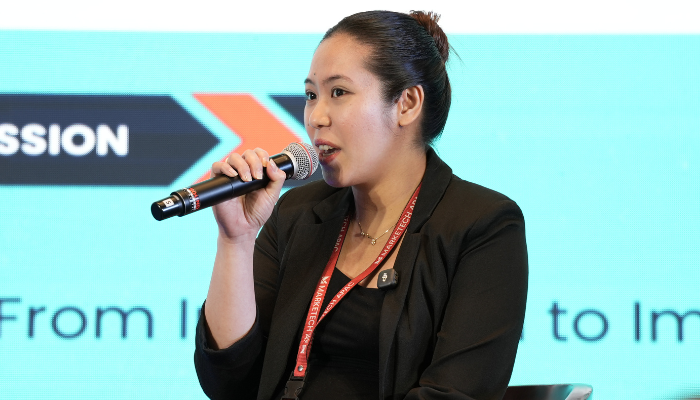
Another sector that also experiences a lot of these changing consumer behaviours is the consumer technology space. With reviews and comments from netizens potentially being just ‘noise’ for brands, Joepy shares how brands should learn to take a step back and determine the real feedback versus ‘online noise’.
“When that happens to your brand, you have to step back. There’s nothing wrong if you listen to the bad comments about your products or your brands, because that’s the point of improvement for your brand. So you really have to listen. But to really identify what’s loud noise and what’s authentic or what’s real, ghost marketing comes into play as well,” she explained.
Speaking of ghost marketing, Joepy shares three ways they’re gathering authentic feedback: offline strategy for product pre-orders, scouring online forums and communities, and creating your own community.
Through this, she says that this allows them to discern the true customer versus mere ‘bashers’. “Check what’s outside the limelight so that you can pivot your brand and your product,” she noted.
Creating reach that feels authentic
Over at Timezone, January highlights how, despite having national-centric campaigns, they always tailor them to suit local market needs.
“Our hero message remains the same. But on top of that, there’s a supplemental message that we add to these campaigns to make it more localised,” she shared.
January further explained, “Even though we retain the hero message, which is bringing or celebrating every moment at Timezone or creating beautiful memories with your families and peers, there’s always a supplemental message that you can add to that to make it more effective to the local market that you have.”
For instance, if a venue is located in an area where it’s mostly students, Timezone will create products and different campaigns that are specific to the community, so that it resonates well with the market.
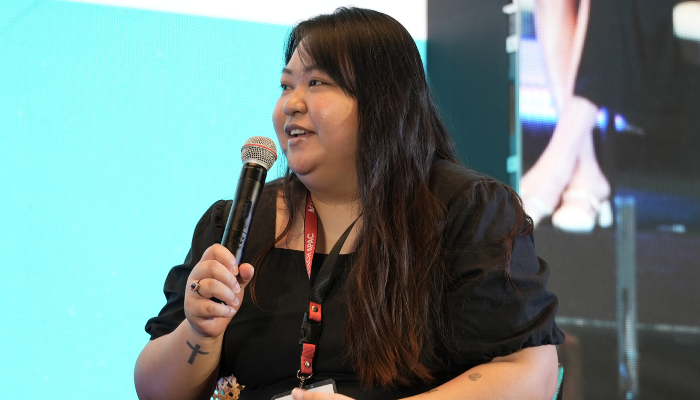
“Even though we retain the hero message, which is bringing or celebrating every moment at Timezone or creating beautiful memories with your families and peers, there’s always a supplemental message that you can add to that to make it more effective in the local market that you have,” she shared.
Speaking of creating campaigns that connect well with target audiences, Roshan also shared how scaling something–luxury, for instance–it isn’t just about the signal they are getting from a data point of view, but rather the emotional connection they get from the guests.
“Once you feel you are being spoken to, once you feel you are seen, once you feel that the person truly knows you and not just because you gave away the signal, you connect. And when you connect, that connects to you being able to decide with the brand or against the brand,” she shared.
Staying grounded while scaling fast
When asked for advice on how brands can stay grounded while scaling fast, Roshan quips about always staying human, which means learning how to take a step back.
“Take a step back and see what’s human. See what’s important to your consumers, go back to the basics of marketing in terms of what they are seeking, what they need, what is the message you want to connect with and go back to that, then things will kind of simplify for me,” she shared.
Meanwhile, Joepy stated that brands should check the age group of their organisation because if they listen to different age groups within the company, they will definitely teach them a lesson.
“Gen Z should educate the millennials and the boomers on how to integrate AI to improve the marketing executions and strategies. Millennials should bridge the generational gap in understanding of boomers, she said.
Speaking about the older generation of marketers, she shared, “You have to listen to them because they’re the ones who are not really that aggressive in the market and they see the real problems.”
Lastly, January put it bluntly by stating that marketers should ignore the pressure in trying to be in a thousand channels at once.
“Just keep remembering that the point is not to say a thousand things or be in a thousand places but to keep repeating the brand promise and experience that you can actually be proud of,” she concluded.
****
Ultimately, the panel made it clear: the engagement engine isn’t about complex technology or ubiquitous presence, but rather the human element. By focusing on creating seamless, emotionally resonant experiences, listening intently to authentic customer signals, and grounding their scaling efforts in a clear, repeatable brand promise, these Philippine marketing leaders are defining a future where every customer interaction—digital or physical—is a powerful driver of measurable, long-term impact.
The “What’s NEXT in Marketing” conference series brings together industry leaders and practitioners to explore emerging trends, evolving consumer behaviours, and forward-looking strategies set to influence the region’s marketing landscape.
With local editions happening soon across Singapore, Indonesia, Thailand, Malaysia, and Hong Kong, the series will continue to explore what lies ahead for the future of marketing across Asia-Pacific this 2026 and beyond.


![[Featured Image] AI Visibility Forum 2026](https://marketech-apac.com/wp-content/uploads/2026/04/Featured-Image-AI-Visibility-Forum-2026.png)