
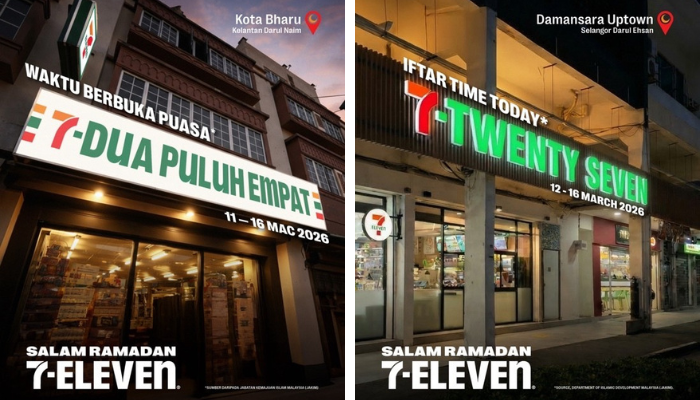
Each evening during Ramadan, millions of Malaysians pause for the same moment—the exact time of iftar. It’s a ritual defined by precision, varying by state and shifting daily, yet deeply ingrained in the rhythm of everyday life. Tapping into this shared anticipation, 7-Eleven found a way to embed itself into the occasion—not by promoting its offerings, but by transforming its very identity into a real-time signal of when to break fast.
Done alongside TBWA\Kuala Lumpur, the 7-Eleven logo was updated daily across social and digital out-of-home, localised by state to indicate the time of iftar.
Speaking to MARKETECH APAC, Mo Nazmi Ahmad, creative director at TBWA\ Kuala Lumpur explained that they didn’t approach said campaign as a traditional validation exercise, because it’s a behaviour most Malaysians who fast have grown up with. From childhood, Ramadan has always come with that same daily moment…checking, asking, and waiting for the time to break fast.
“It cuts across age, state and background. Everyone goes through it, every single day. That’s what gave us confidence. It’s not just frequent, it’s shared. When something is that universal, the relevance is already there. We just had to show up and become part of that ritual,” he explained.
In terms of balancing both the brand’s recognisability and adapting to the Ramadan season, Mo Nazmi said that they were quite disciplined about what they didn’t change.
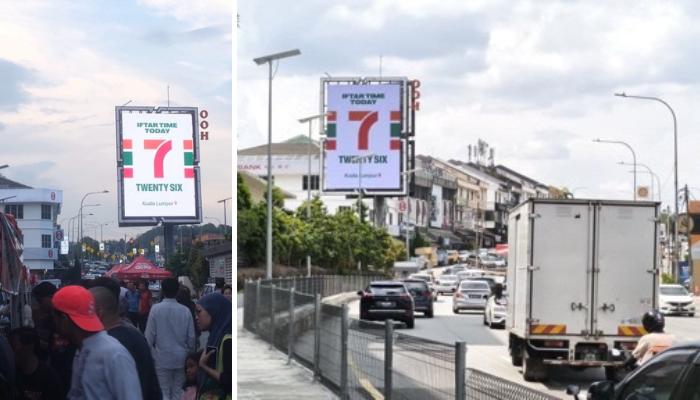
“The 7-Eleven logo is already very recognisable, so we kept the colours, type and overall structure intact. That alone is enough for people to know it’s 7-Eleven. What we changed was the “Eleven”. That’s the part people naturally look at, so turning it into the actual time is what makes them stop and take notice. So while the logo feels familiar at a glance, the detail is what makes it useful. Even though the “Eleven” changes, people still recognise it as 7-Eleven,” he explained.
He also noted that the biggest challenge in this campaign was accuracy. For context, Iftar time isn’t something anyone can get wrong, and it varies by state and changes throughout the month, so they had a team constantly checking and validating the timings, referring to the Department of Islamic Development Malaysia (JAKIM) as the source.
“That meant every update had to be precise before it went out. At the same time, speed was critical. So it really came down to having the right partners… people who could move quickly, and who believed in the idea as much as we did. Once that alignment was there, everything became much easier to execute at pace,” he said.
While the campaign is still ongoing, Mo Nazmi said that the idea was designed to sit right at the moment people are deciding what to do next–when they check the time and get ready to break fast.
“So rather than trying to drive behaviour separately, we focused on being present at that moment, and making 7-Eleven an easy, immediate option. In that sense, the idea helped support the business, naturally leading people towards 7-Eleven’s Ramadan offerings, from 7Savers and 7Meals to CAFe by 7-Eleven,” he said.
When asked what the biggest lesson this campaign offers about creating relevance during high-clutter festive periods like Ramadan, Mo Nazmi said that during Ramadan, there’s a lot of noise–and everyone is trying to say something emotional or meaningful.
“What we realised is, sometimes the most meaningful thing you can do is to be useful. Instead of adding to the conversation, we focused on a very small, very real behaviour, and designed the brand around it,” he concluded.