

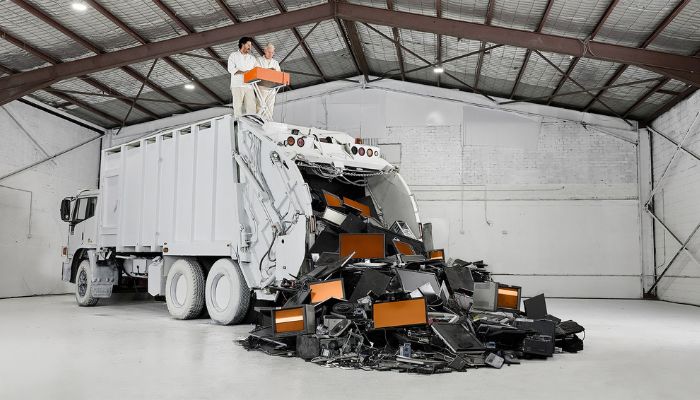
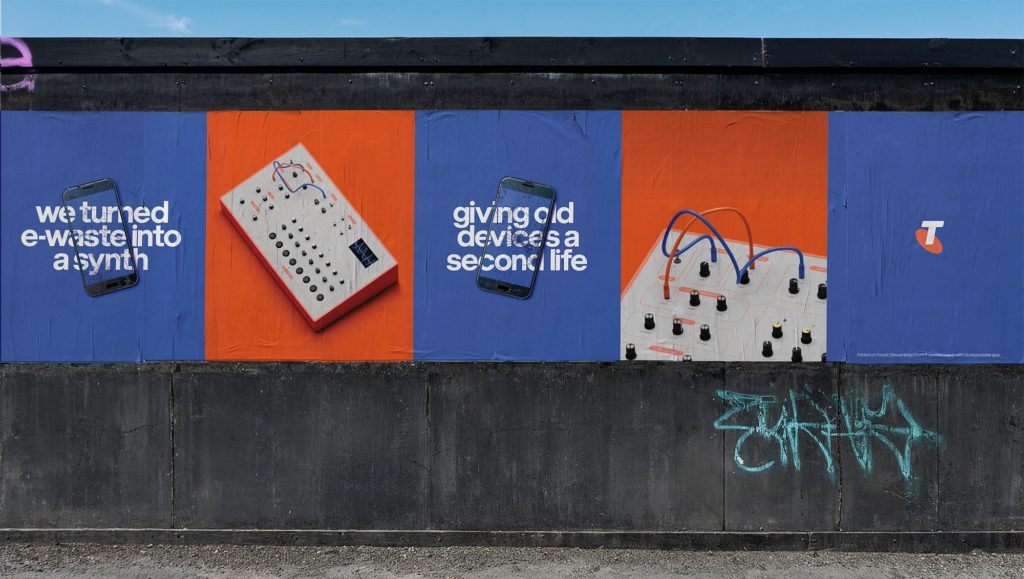
Australia – Telstra has partnered with creative agencies +61 and Bear Meets Eagle On Fire to build a one-off synthesiser made from reclaimed e-waste as part of a campaign designed to highlight Australia’s growing electronic waste problem. The project was created in collaboration with Australian electronic group The Avalanches and designed and built by Scott Stirling.
The campaign aims to encourage Australians to give their old devices a second life rather than discarding them. The initiative is supported by films accompanying the launch, directed by Matt Devine (launch film) and Scott Stirling (behind-the-scenes), and produced by Revolver.
According to campaign data, Australians generate 22kg of e-waste per person annually, positioning the country as one of the highest e-waste producers globally. In response, Telstra has set a sustainability goal to reuse, recycle, repair, or donate one smart device for every two sold by 2030. Rather than promoting this goal through traditional messaging, the integrated campaign demonstrates what discarded devices can be transformed into.
The synthesiser was constructed using recycled components sourced from old phones, modems, soundboards, and even a vintage game controller. The finished instrument will be displayed at Telstra’s flagship Discovery Store on Bourke St, Melbourne, for two months before being relocated to a permanent home.
Speaking about the project, Robbie Chater of The Avalanches said, “We wanted to show that e-waste can be repurposed into something that people can relate to universally. Through music, we are demonstrating the amazing link between sustainability and creativity.”
Alita McMenamin, head of brand, network and sponsorship at Telstra, said, “A lot of households in Australia have a forgotten drawer of old devices that can actually live again in some way. Who better than The Avalanches to inspire people about what those devices could become?”
Blake Crosbie, managing director at +61, added, “Rather than just tell consumers to recycle e-waste we wanted to encourage them to imagine the possibilities a simple action like bringing an old device in can actually make.”

Tom Penny, head of environment at Telstra, said, “Telstra has a long track record supporting customers and community in doing better by the environment, including taking steps to progress a circular economy. This campaign helps to highlight how we’re evolving our approach with a new 2030 target that aims to keep more devices and materials in use for longer.”
The campaign forms part of Telstra’s broader sustainability and circular economy advocacy efforts, using creative storytelling to encourage environmental action among consumers.











![[Statement] AirAsia Ph June 4 2026](https://marketech-apac.com/wp-content/uploads/2026/06/Statement-AirAsia-Ph-June-4-2026.jpg)