The post CICP on viral Ivana Alawi iPhone giveaway post: ‘Gambling-related endorsements deserve a heightened degree of caution and responsibility’ appeared first on MARKETECH APAC.
]]>Speaking exclusively to MARKETECH APAC, CICP stated that from an ethical standpoint, they believe creators should carefully consider the real-world impact of the products and services they choose to promote, adding that the same amount of money can mean very different things to different people.
Using an example, CICP notes that for one individual, ₱1,000 (around US$16) may come from discretionary income set aside for leisure. For another, that same amount may be intended for groceries, medicines, rent, or other essential household expenses.
“Our ethical concern is not whether someone chooses to gamble, but whether creator endorsements may influence people to gamble with money they cannot reasonably afford to lose. That is not something CICP would ethically encourage,” the council said.
‘Ethical responsibility should extend beyond regulatory compliance’
CICP has also mentioned that the ethical concern about these endorsements is not a person’s income level, but whether they are being encouraged to risk money they cannot afford to lose.
“While creators cannot control every decision made by their audience, we believe they should recognise the influence they have and exercise that influence responsibly,” they added.
The council has also noted that they recognise that many consumers do not immediately distinguish between licensed and unlicensed gambling platforms when they first encounter creator endorsements–as well as how the Internet has made gambling more accessible to the masses.
“Because of the trust that creators build with their audiences, endorsements can normalise gambling behaviour before viewers have had the opportunity to determine whether a platform is legally licensed or appropriately regulated,” CICP explained.
They added, “While PAGCOR regulates licensed operators within the Philippines, consumers can also access offshore platforms that fall outside Philippine licensing and regulatory jurisdiction. This reinforces our view that ethical responsibility should extend beyond regulatory compliance to creators, brands, agencies, and platforms themselves.”
CICP has also encouraged creators, brands, agencies, and platforms to exercise greater caution when engaging in gambling-related campaigns, even where these involve legally licensed operators.
Complementing regulatory frameworks and promoting ethical practices
It should be noted that the CICP has previously released a statement in 2025, stating that it does not condone the use of creators and influencers to promote illegal online gambling in any form. It has also previously advised its members to avoid promoting such activities due to the significant risk of public harm, including the exploitation of individuals and communities.
When asked about whether this statement blankets both legal and illegal online gambling platforms, CICP said, “From the Code alone, the distinction is clear. The Code expressly prohibits the promotion of illegal gambling. It does not contain a blanket prohibition against promoting PAGCOR-licensed operators.”
While CICP notes that they are not a regulator, they recognise any current frameworks to promote responsible influence.
“Our role is to complement these regulatory frameworks by promoting ethical practices and responsible influence within the creator industry,” the council stated.
In July 2025, the Philippine Amusement and Gaming Corporation (PAGCOR) and the Ad Standards Council (ASC) agreed to sign a Memorandum of Agreement to regulate online gambling platforms’ advertisements.
However, when MARKETECH APAC visited the ASC official website for said circular, the circular only came into effect on June 24, 2026, directed towards industry bodies like the 4AS Philippines, Philippine Association of National Advertisers (PANA), Media Specialists Association of the Philippines (MSAP), Digital Marketing Association of the Philippines (DMAP), among others.
“Effective immediately, please be advised that any advertising material placed in any form of medium (Broadcast, Digital, Print, or OOH) should not show or mention casino games and equipment, such as, but not limited to, roulette, baccarat, blackjack, slot machines, cards, chips, dice, and other gambling paraphernalia,” the circular on advertising materials on gambling operators said.
ASC has also added that any material seen with any of the abovementioned elements shall be issued a corresponding Cease and Desist Order by the ASC, a copy of which shall be shared with the Philippine Amusement and Gaming Corporation (PAGCOR).
MARKETECH APAC has reached out to ASC to clarify whether the circular will also include online advertisements or influencer promotions.
Ivana Alawi, a popular Filipino influencer with more than 50 million followers, was tapped by Casino Plus last month to promote a so-called ‘responsible gaming push’ by the platform. Aside from this endorsement, Ivana was previously an ambassador for Bet88, another online gambling platform, from 2022 until early this year.
The post CICP on viral Ivana Alawi iPhone giveaway post: ‘Gambling-related endorsements deserve a heightened degree of caution and responsibility’ appeared first on MARKETECH APAC.
]]>The post Filipino commuters can now tap bank cards to ride LRT-2 appeared first on MARKETECH APAC.
]]>The system integrates international Visa and Mastercard networks, Google Pay, and GCash QR codes into a single fare gateway alongside existing ticketing methods.
Developed by Rizal Commercial Banking Corp (RCBC) in partnership with the Department of Transportation (DOTr) and the Light Rail Transit Authority (LRTA), the upgrade turns everyday payment tools into instant train tickets, removing the requirement to queue for single-journey tokens or reload proprietary stored-value cards.
What sets this deployment apart from earlier transit updates is its all-in-one, bank-agnostic infrastructure.
While previous pilots introduced card-tapping on select bus routes and parts of the Metro Rail Transit Line 3 (MRT-3) in 2025, the LRT-2 network is the first in the country to consolidate international EMV standards—using Visa’s Mobility and Transport Transaction framework and Mastercard’s “Pay As You Go” capability—with domestic mobile fintech tools under one automated fare architecture.
By grouping QR and card payments together, the gateway remains accessible to both unbanked local commuters dependent on mobile wallets and international travelers using foreign bank accounts.
The infrastructure push aims to solve recurring supply chain vulnerabilities in the capital’s transit system.
For years, localized microchip shortages triggered severe deficits of physical “Beep” cards, forcing passengers into long queues at ticketing terminals during rush hour.
Transport Undersecretary for Railways Timothy John Batan noted that moving away from strict reliance on single-system transit cards will ease station bottlenecks, adding that data from the LRT-2 pilot will guide the rollout of the broader Philippine Automated Fare Collection System across the rest of the country’s rail networks, including the LRT-1.
For the central bank, embedding payment options into public transit is a deliberate strategy to broaden digital financial inclusion.
The LRT-2 line moves over 160,000 daily passengers, bridging Manila’s university district with eastern Metro Manila and Rizal province.
To accelerate adoption, RCBC is running a promotional campaign until July 31, using cashback rebates to drop individual fares to just one peso for its debit, credit, and MySSS DiskarTech cardholders.
Beyond daily convenience, the anonymised travel data recorded at the turnstiles will be analysed by the DOTr to map commuter travel patterns and support future public infrastructure investments.
The post Filipino commuters can now tap bank cards to ride LRT-2 appeared first on MARKETECH APAC.
]]>The post CHAGEE turns tea into an art experience with Tate-inspired installation via TBWA\Singapore appeared first on MARKETECH APAC.
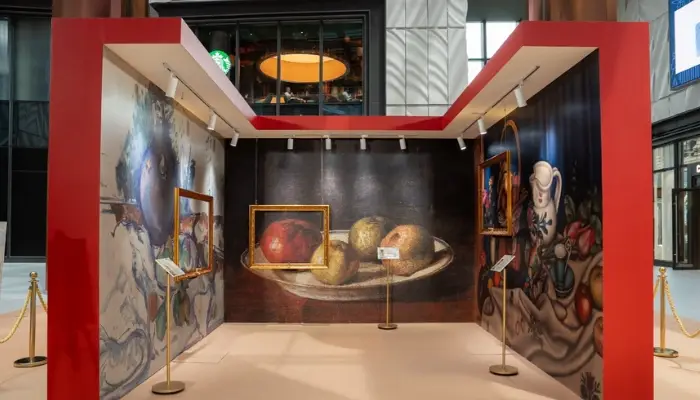
]]>Created as the latest activation under CHAGEE’s regional Sip A New Classic campaign, the installation invites visitors to experience art through tea by dispensing different variants of the brand’s Apple English Breakfast Tea from framed interpretations of artworks in Tate’s collection.
Rather than separating refreshments from art, the concept blends both into a single experience, encouraging visitors to engage with culture through taste, storytelling and design.
The installation features interpretations inspired by three artworks from Tate’s collection—Henri Fantin-Latour’s A Plate of Apples, Paul Cézanne’s Still Life with Water Jug, and Mark Gertler’s The Basket of Fruit—each paired with a different tea variant.

According to Emmanuel Sabbagh, Chief Strategy Officer at Omnicom Advertising Asia and TBWA\Singapore, the campaign explores how enduring cultural traditions remain relevant by evolving with new generations.
“The most enduring classics aren’t preserved by staying the same: they survive because every generation finds its own way to reinterpret them. Tea and art have both travelled through time by constantly evolving while staying true to their essence.”
He added that the campaign is designed to transform an everyday tea ritual into “a contemporary cultural experience” rather than simply placing artwork on product packaging.
The campaign builds on the journey of English Breakfast tea, tracing its evolution from Chinese tea traditions to becoming a British classic.
CHAGEE said the Apple English Breakfast Tea range reinterprets that heritage through a contemporary lens while reflecting the shared philosophy behind its partnership with Tate.
Eugene Lee, Vice President and Chief Marketing Officer for CHAGEE APAC, said the collaboration connects the product’s distinctive apple flavour with the heritage of English Breakfast tea.
“Creativity gets people talking, and that’s what we loved about the idea from TBWA.”
Meanwhile, Rosey Blackmore, Director of Licensing and Merchandising at Tate, said the partnership extends audience engagement with the museum’s collection beyond its physical galleries.
“This partnership has allowed CHAGEE to create a product range that thoughtfully brings together art, design and everyday ritual. We are excited to see audiences discover these artworks in a new context and through a unique cultural experience.”
Drinkable Masterpieces forms part of CHAGEE’s broader Sip A New Classic platform, which aims to reinterpret heritage through contemporary experiences by combining tea, art and culture.
The post CHAGEE turns tea into an art experience with Tate-inspired installation via TBWA\Singapore appeared first on MARKETECH APAC.
]]>The post 303, Mediahub, and Pembleton form strategic alliance to expand integrated agency offering across Australia appeared first on MARKETECH APAC.
]]>Under the alliance, the three agencies will collaborate on projects and share resources where capabilities align, while retaining their individual ownership structures and brands.
The move strengthens 303 and Mediahub’s presence in Melbourne alongside their existing operations in Sydney and Perth, while giving Pembleton access to on-the-ground support beyond Victoria.
Anthony Gregorio, Executive Chairman at 303, said evolving client expectations and opportunities in the Melbourne market drove the partnership.
“In a world where the agency landscape is changing rapidly, clients increasingly want experienced senior people in multiple locations actively working on their business. This alliance allows senior talent from both organisations in several Australian markets to collaborate closely and deliver seamless outcomes for clients, while remaining agile and efficient.”
The alliance builds on longstanding relationships between the leadership teams.
Pembleton Directors Alex Speakman, Simon Bagnasco and Mac Wright previously worked with Gregorio at Saatchi & Saatchi Australia, creating what the agencies described as a strong foundation of trust and collaboration.
Matilda Hobba, Director and Managing Partner at Pembleton, said the arrangement enables the agency to broaden its reach without compromising its independent operating model.
“Pembleton’s model has always seen senior brains on the tools end-to-end, supported by bespoke specialist teams to execute the thinking. The alliance with 303 provides Pembleton with a greater pool of specialists to tap into on the projects that need it, along with the opportunity to support our friends at 303 where relevant.”
She added that remaining independent allows both agencies to continue structuring projects and client relationships in the way that delivers the strongest outcomes.
Gregorio said the agencies share an entrepreneurial culture that extends beyond the partnership’s commercial objectives.
According to Gregorio, the combined expertise will help both businesses pursue growth opportunities while expanding their integrated service offering across strategy, creative, media, digital, PR and retail activation.
The alliance follows 303’s return to independent ownership after dropping the MullenLowe branding in December 2025.
At the time, the agency reaffirmed its integrated business model by bringing together its creative, media, strategy, digital, PR and retail activation capabilities alongside Mediahub.
Since the rebrand, 303 and Mediahub have secured new client wins including the Australian Cancer Research Foundation and Cancer Council’s Australia’s Biggest Morning Tea.
The agencies were also recently appointed to the Western Australian Government’s Common Use Arrangement (CUA) panel for media strategy and buying.
The post 303, Mediahub, and Pembleton form strategic alliance to expand integrated agency offering across Australia appeared first on MARKETECH APAC.
]]>The post Astro unveils new leadership structure to accelerate growth and digital transformation appeared first on MARKETECH APAC.
]]>The move comes as the company continues its transformation efforts amid changing consumer habits and an increasingly competitive media landscape.
Under the new structure, Astro has redesignated Tai Kam Leong as Chief Commercial Officer (CCO), where he will oversee the company’s integrated commercial strategy across consumer, enterprise and advertising businesses.
In his expanded role, Tai will lead efforts to unify Astro’s revenue streams, strengthen market reach and create greater value for advertisers, partners, and customers.
Astro has also established the new role of Chief Digital Growth Officer (CDGO), appointing Rene Menezes to lead KULT, Digital Business, and Digital Campaign & Operations.
Menezes will be responsible for identifying and scaling new revenue opportunities as Astro continues to invest in its digital growth agenda.
Meanwhile, Christinne Lim has been appointed Chief Marketing Officer (CMO), taking charge of the company’s marketing and communications functions to strengthen brand visibility and audience engagement.
Laila Saat has also assumed the newly created position of Chief Regulatory & Corporate Affairs Officer (CRCAO), overseeing regulatory affairs, corporate communications and environmental, social and governance (ESG) initiatives.
According to Astro, the appointments are intended to support the company’s broader transformation agenda, which includes initiatives such as Astro X3 and continued investments in premium local content and integrated advertising solutions.
The refreshed leadership team is expected to play a key role in driving commercial excellence, strengthening stakeholder engagement and delivering sustainable growth across Astro’s business.
With the appointments, Astro aims to enhance its ability to respond to evolving market opportunities while creating long-term value for customers, advertisers and shareholders.
The post Astro unveils new leadership structure to accelerate growth and digital transformation appeared first on MARKETECH APAC.
]]>The post Klook, Korea Tourism Organization renew partnership to boost regional tourism, AI innovation appeared first on MARKETECH APAC.
]]>The renewed partnership will focus on four key areas: supporting the digital transformation of Korean tourism businesses, promoting regional destinations, developing marketing campaigns for free independent travellers (FIT), and building smart tourism solutions through traveller insights and artificial intelligence.
The agreement comes as demand for travel beyond Seoul continues to rise.
The companies said the partnership aims to capitalise on this shift towards experience-led travel by increasing international awareness of Korea’s regional destinations and encouraging a more balanced distribution of visitors across the country.
Sunghyeuck Park, President and CEO of the Korea Tourism Organization, said the collaboration will help make Korea more accessible while supporting local tourism businesses.
“Korea continues to capture the imagination of travellers around the world, driven by its rich culture, vibrant cities, and diverse regional destinations. Through this partnership with Klook, we aim to make it even easier for international travellers to discover more of Korea, while supporting local tourism businesses in adapting to changing traveller needs.”
Park added that combining KTO’s tourism network with Klook’s digital platform and traveller insights would create new opportunities for the country’s tourism industry.
Klook also plans to leverage its Kreator Program, which comprises more than 30,000 travel creators across 88 markets and has generated over 1.8 billion content views, to promote Korean destinations among Millennial and Gen Z travellers across Asia-Pacific, North America and Europe.
CS Soong, Vice President of Corporate Development at Klook, said the partnership would strengthen both destination discovery and industry growth.
“Working closely with KTO allows us to combine digital access, traveller insights, and destination storytelling to create meaningful ways for travellers to experience Korea. At the same time, this partnership will help more Korean tourism businesses connect with international travellers and participate in the growth of the tourism economy.”
The renewed agreement builds on previous collaborations between the two organisations. In 2023, Klook and KTO partnered to improve domestic transport access for international visitors through real-time express bus bookings.
Earlier this year, Klook also introduced real-time KORAIL ticket bookings, allowing travellers to search schedules, reserve seats and board trains using digital vouchers through its platform.
Together, the organisations said they will continue investing in digital tools, AI technologies and destination marketing to strengthen Korea’s tourism ecosystem while encouraging travellers to explore beyond its major gateway cities.
The post Klook, Korea Tourism Organization renew partnership to boost regional tourism, AI innovation appeared first on MARKETECH APAC.
]]>The post Changi Airport awards contract for first standalone office development at Terminal 3 appeared first on MARKETECH APAC.
]]>Located on the landside of Terminal 3, the development will provide approximately 9,600sqm of purpose-built office space across five levels to accommodate growing demand from airlines, airport partners and businesses requiring an on-site presence.
The building will also be integrated with a revamped coach stand and feature its own dedicated drop-off point and lift lobby.
The project comes as Changi Airport’s existing landside office capacity approaches its limits. Across Terminals 1 to 4, the airport currently provides around 80,000sqm of office space supporting airlines, ground handlers, government agencies, concessionaires, contractors and Changi Airport Group’s own operations.
According to CAG, the additional workspace is intended to support the airport ecosystem’s continued growth in the lead-up to the opening of Terminal 5 in the mid-2030s.
Designed with tenant wellbeing in mind, the new office block will feature cascading landscaped terraces on every floor, providing access to natural light and outdoor spaces.
A large communal terrace on Level 2 will serve as a shared venue for activities and programmes for tenants.
Steve Tay, Vice President of Rentable Properties at Changi Airport Group, said the development reflects the airport operator’s continued investment in supporting its aviation community.
“At the heart of Changi’s success is a strong and closely connected airport community. This development will provide a conducive and well-designed workspace environment for our partners, supporting their operational needs while enabling closer collaboration across the airport ecosystem.”
“It also reflects CAG’s continued investment to support the air hub’s growth,” Tay said.
Construction will be carried out in two phases to minimise disruption to airport operations. The office building is expected to be completed in the first half of 2028, followed by completion of the upgraded coach stand in the second half of 2028.
The development is the latest infrastructure investment by CAG as it continues to expand facilities to support rising passenger traffic and operational demand before Terminal 5 becomes operational in the next decade.
The post Changi Airport awards contract for first standalone office development at Terminal 3 appeared first on MARKETECH APAC.
]]>The post Cadbury Malaysia transforms Kuala Lumpur café into live theatre for new campaign via Ogilvy appeared first on MARKETECH APAC.
]]>Created in partnership with Ogilvy Malaysia, the activation turned a café in Petaling Street into a stage where passers-by could watch a story unfold between three friends, inspired by the small moments of kindness that define Malaysian culture.
The campaign builds on Cadbury’s global ‘Made To Share’ platform, which celebrates everyday generosity through the brand’s signature packaging design that highlights simple, relatable acts between family and friends.
For the Malaysian campaign, Ogilvy reimagined the packaging concept as a storytelling device, extending the familiar grid design into a live theatre experience that combined animation, performance, and technology.
At the heart of the activation was an innovative transparent LED screen installed across the café’s front window, allowing animated visuals to interact with the live actors performing behind it.
Developed in collaboration with local theatre company fskl.works, the production featured four live performances throughout the day, each carefully choreographed to align with the animated ‘Made To Share’ visuals.
The campaign aimed to spotlight the often-overlooked moments of generosity that happen in everyday life, reinforcing Cadbury’s longstanding association with sharing and human connection.
The live performance was later adapted into a film, extending the campaign’s reach beyond the café and allowing audiences to experience the story online.
Beyond the live performances, the activation was supported by a broader 360-degree campaign that included social media teasers and on-ground experiences where visitors could create personalised Cadbury Dairy Milk bars.
Graham Drew, Chief Creative Officer at Ogilvy Group, said the idea stemmed from viewing Cadbury’s packaging as a platform for storytelling rather than simply a product design element.
“Each grid on Cadbury’s packaging reveals an insightful generous moment. In essence it’s a storytelling platform – so we thought what if we extended it? What if the everyday acts of generosity happening around us weren’t hidden in plain sight, but placed centre stage? What if we wrote a play using the grids to reveal the generous ways people show up for one another every day?” said Drew.
Meanwhile, Cadbury Malaysia’s marketing team said the campaign offered a fresh way to celebrate Malaysian generosity by placing familiar moments centre stage in an unexpected setting.
Mei Sin, Marketing Director at Cadbury Malaysia, said, “The MTS is a global platform, but nobody has turned it into a live performance before. What we loved about this idea was how it took everyday Malaysian moments of generosity and placed them right in plain sight, in such a surprising and entertaining way. It reminded us all that generosity doesn’t always arrive in grand gestures. More often, it’s found in the little things we do for one another every day.”
With the activation, Cadbury Malaysia has demonstrated how brand storytelling can move beyond traditional advertising by transforming an everyday space into a memorable cultural experience.
The post Cadbury Malaysia transforms Kuala Lumpur café into live theatre for new campaign via Ogilvy appeared first on MARKETECH APAC.
]]>The post CNB, Ogilvy Singapore return with second-year ‘Uninfluenced’ campaign to counter permissive drug narratives appeared first on MARKETECH APAC.
]]>Building on last year’s campaign, which centred on the immersive escape room experience The Trip: What Happened in Larspura, the latest phase shifts its focus to what the organisations describe as “permissive drug talk”—casual comments, jokes and rationalisations that can make drug abuse appear less harmful or socially acceptable.
To make these subtle conversations more visible, the campaign introduces vibrant 3D speech bubbles carrying common permissive statements.
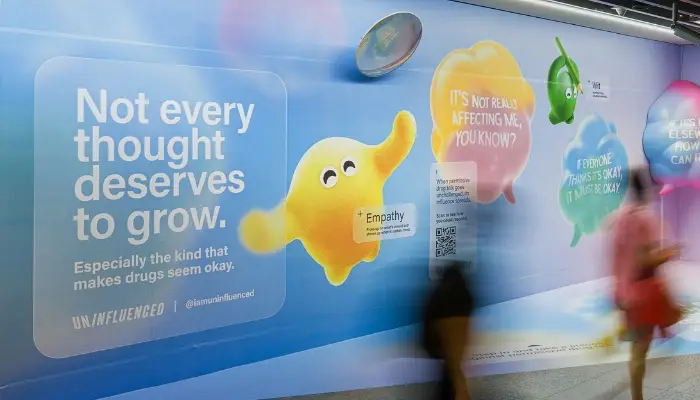
These appear across MRT platform screen doors, bus shelters, wallscape installations and inflatable displays. By scanning QR codes displayed alongside the installations, users can access an augmented reality (AR) experience that allows them to virtually “take down” the speech bubbles.
The AR experience also includes a personality quiz that matches participants with one of four ‘Uninfluenced Pals’—Gut, Wit, Reason or Empathy—each representing a different approach to responding to permissive drug conversations.
The tool is designed to help youths understand how they can confidently speak up when encountering such narratives.
The campaign extends across paid media, social platforms, content partnerships, digital experiences and on-campus activations at Institutes of Higher Learning (IHLs), where students can participate in interactive games and collaborative exercises that simulate real-world conversations about drugs.

Among the highlights is the “Takedown Battle”, a larger-than-life game where participants work together to burst oversized speech bubbles carrying permissive messages before learning practical ways to challenge similar conversations in everyday situations.
According to Kaye Chow, Deputy Director (Partnership & Outreach) at CNB’s DrugFreeSG Office, the campaign recognises the influence everyday conversations can have on young people’s perceptions of drugs.
“CNB’s Uninfluenced campaign seeks to equip them with the awareness and confidence to think critically about these messages, and to respond constructively when they come across views that may normalise or downplay drug harm,” Chow said.
For Ogilvy Singapore, the creative challenge was making invisible social influences tangible.
Troy Lim, Group Creative Director at Ogilvy Singapore, said the campaign visualises permissive drug narratives so young people can recognise and respond to them more easily.
“Permissive drug talk is powerful precisely because it doesn’t feel dangerous—it hides in jokes and casual rationalisations,” Lim said. “Through AR, gamification and our four Pals—Gut, Wit, Empathy and Reason—we gave permissive thinking a shape, and its audience a way to answer back.”
The second phase of Year Two, scheduled to launch in October, will further equip the youth with practical skills to initiate conversations, call out permissive thinking and encourage peers to stay resilient against drug influences.
The campaign continues CNB and Ogilvy Singapore’s broader effort to modernise preventive drug education by using immersive technology, interactive storytelling and youth-focused experiences to encourage critical thinking beyond traditional awareness messaging.
The post CNB, Ogilvy Singapore return with second-year ‘Uninfluenced’ campaign to counter permissive drug narratives appeared first on MARKETECH APAC.
]]>The post Beyond personalisation: Braze’s second ‘Grow With Braze’ event at Jakarta to tackle trust, AI, and the future of loyalty appeared first on MARKETECH APAC.
]]>As consumers demand relevant, tailored experiences while guarding their data more closely than ever, brands are being pushed to rethink how they earn consent, build lasting loyalty, and humanise every touchpoint.
In order to continue fostering discussions on what’s next for customer engagement, Braze is hosting its flagship event ‘Grow With Braze’ for the second time on 4 August 2026, at The Westin Jakarta, Indonesia.
The flagship event, supported by regional marketing and advertising trade publication MARKETECH APAC, is designed to empower marketers, innovators, and industry leaders. The event promises a dynamic platform for learning, networking, and elevating customer engagement strategies in one of Southeast Asia’s most vibrant markets.
The event’s lineup of speakers include:
- Duardi Prihandiko, SVP Head of Brand & Communication at BCA Digital
- Ruli Himawan, Head of Marketing Communications at BCA Syariah
- Cassandra Maharani Putri, Head of Brand Activation, BODYPACK
- Bill Magnuson, CEO at Braze
- Franz Sihaloho, Country Director Indonesia at Braze
- Henry Roberto, Solutions Consultant at Braze
- Sam Meyer, Area Vice President, Asia at Braze
- Shahid Nizami, VP APAC & GCC at Braze
- Grace Surya, Marketing Director at Jiwa Group
- Coki Wicaksono, VP Marketing & Branding at Pertamina Bina Medika IHC
- Iman Muhammad, Managing Director, Telcowin
Joven Barceñas, Founder and CEO of MARKETECH APAC, said, “Our partnership with Braze continues to go from strength to strength, and we’re delighted to once again bring ‘Grow with Braze’ to Indonesia. Being part of these conversations in such a dynamic market is genuinely exciting for us. At MARKETECH APAC, we remain committed to championing initiatives that equip the marketing community with the tools to deliver smarter, more impactful customer engagement.”
Learn more about the event’s agenda by checking out the event’s official website HERE.
For more details on how you can register for the event, contact Resnher Cajida at [email protected].
The post Beyond personalisation: Braze’s second ‘Grow With Braze’ event at Jakarta to tackle trust, AI, and the future of loyalty appeared first on MARKETECH APAC.
]]>